
How to predict the General Election – the exit poll explained
We’ve all seen them on the TV, often set to dramatic music – the exit poll.

They emerge at 10pm on election day, the moment the polls close.
And they confidently predict who will form the next government, bringing a jolt of joy to those in front and the prospect of a long and gloomy night ahead for those left behind.
They have been pretty accurate over the years, correctly predicting clear victories for Boris Johnson and also indicating less decisive results, such as the elections that brought in David Cameron as part of a coalition with the Liberal Democrats.
But just how do exit polls get put together?
And why are they generally an accurate prediction of the election results, coming many hours before most constituencies have declared?
Much work goes into the polls. After all, the reputation of those who organise them is at stake.
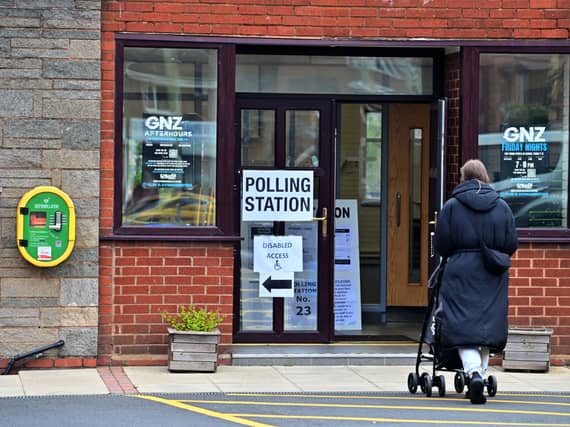
Exit polls take place at about 144 polling stations across the country, with tens of thousands of people asked to privately fill in a replica ballot as they leave, to get an indication of how they voted.
A replica ballot box is also used as part of the process.
Polling expert Sir John Curtice said it’s done in this way to “maximise the confidentiality of people’s votes”.
He added: “To ask them to tell an interviewer, then they might be reluctant to do that, so you’re trying to minimise the level of refusal, which is always an issue.”
Typically, fieldworkers of the polling company Ipsos Mori descend on the same polling stations at every election.
These have been chosen to be demographically representative of the country, with rural and urban seats, and weighted slightly in favour of marginal areas.
Sir John said: “Wherever possible we go back to the same places as last time. The method of the exit poll is that you compare the results in the selected polling stations this time, with the results of the exit poll last time.”
The number of people approached at a polling station is known as a “systematic sample”, Sir John said, and the size of the samples varies according to the registered electorate for that area.
The accuracy of exit polls seems to have improved over time.
In 1974, the first British exit poll predicted a Labour majority of 132, but the actual majority was three.
But in each of the past few elections the exit poll, which is published shortly after 10pm, has produced a very accurate projection of the actual result.
Sir John, professor of politics at Strathclyde University in Glasgow, said: “It’s tended to be relatively accurate.
“It’s not perfectly accurate, but there’s been a number of occasions in which it has ended up proving rather more accurate than what the opinion polls have been.
“Not that I’m suggesting that’s necessarily going to be the case this time but, on occasions like 2015 and 2017, the exit polls proved to give a better guide.”
In 2015, the exit poll proved more accurate than opinion polls at the time, but it did not predict a Conservative majority.
More recently, in 2017 it correctly predicted the Conservatives would be the largest party, but the exit poll stopped short of saying there would be a hung Parliament.
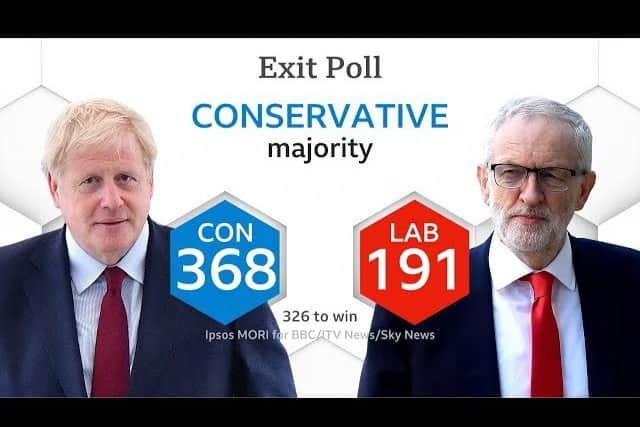
In 2019, the exit poll predicted a Conservative majority of 86 seats, which was very close to the final 80-seat margin of victory.
The Ipso Mori poll predicted Boris Johnson's Conservatives would win 368 seats with Jeremy Corbyn winning 191 seats for Labour. The actual result was 365 for the Tories and 202 for Labour.
Comment Guidelines
Iconic Media encourages reader discussion on our stories. User feedback, insights and back-and-forth exchanges add a rich layer of context to reporting. Please review our Community Guidelines before commenting.