
Plan for new Staffordshire 'super-council' revealed

Government says shake-up will create a more streamlined services
Staffordshire will be carved up into two new ‘super-authorities’, replacing all the existing district and county councils, under a government shake-up.
The changes will take effect from 2028.
The existing district councils covering South Staffordshire, Cannock Chase, Stafford and Lichfield will merge with those for East Staffordshire and Tamworth to form a new all-purpose council serving the south of the county, serving a population of 682,775.
Stoke-on-Trent, Newcastle-under-Lyme and Staffordshire Moorlands will be merged into a single authority covering the north of the county, serving a population of 494,803 .
Staffordshire County Council will disappear under the shake-up.
Parish councils, including Lichfield City Council, will not be affected by the changes.
It will potential leave the town of Stafford without its own council for the first time since 1613, prompting Councillor Aidan Godfrey, leader of Stafford Borough Council, to campaign for a new parish council to take its place.
Councillor Martin Murray, leader of Staffordshire County Council, said while it was not the authority’s preferred option, the soon-to-be disbanded authority would work to make the change as smooth as possible.
Elections for the new ‘shadow authorities’ will be held next year, ahead of the existing councils being wound up the following year.
It is not clear yet what the two new councils will be called.
A similar shake-up is planned in Worcestershire, with the seven existing councils being replaced by two unitary authorities, one covering Wyre Forest, Redditch and Bromsgrove, and the other serving Worcester, Wychavon and Malvern Hills. Worcestershire County Council will be disbanded.
Under the present system, services are split between local district councils, which are responsible for waste services, planning, and housing, while strategic matters such as highways, education and social care are managed by the county council.
Councillor Murray said: “While the north-south option was not what we put forward, it also follows the Government’s rules, has clear strengths and is financially viable in the long term.
“The test now is simple: residents must see stable services, clear decisions and no unnecessary disruption. We will work professionally with neighbouring councils to make the change happen safely, with residents’ needs at the heart of the process.”


Councillor Doug Pullen, leader of Lichfield District Council, said while he did not agree with the Government’s decision, he too would be working to make the transition effective.
He assured residents there would be no immediate impact on services.
“We have always been clear that this was not a change we sought, and throughout this process we put forward the proposal we believed would best serve our residents and communities,” he said.
“While today’s decision is not the outcome we preferred, the Government has now made its decision.
“Our priority is to work positively and constructively with our neighbouring councils and Government to ensure the transition is well managed, protect the services residents rely on and make sure the interests of Lichfield District continue to be strongly represented.
“Residents should be reassured that there will be no immediate changes to the services they receive. We remain committed to delivering high-quality services throughout the transition and will continue to keep our communities informed as further information becomes available.”

Steve Reed, Secretary of State for local government, said the changes were part of a process to simplify local government and increase efficiency by reducing bureaucracy, and end the situation where people had to deal with fragmented services across county and district councils.
He said: “We're shaking up local government so that people get the services they deserve, cleaner streets, better care, and money spent on what matters most to local people,” he said.
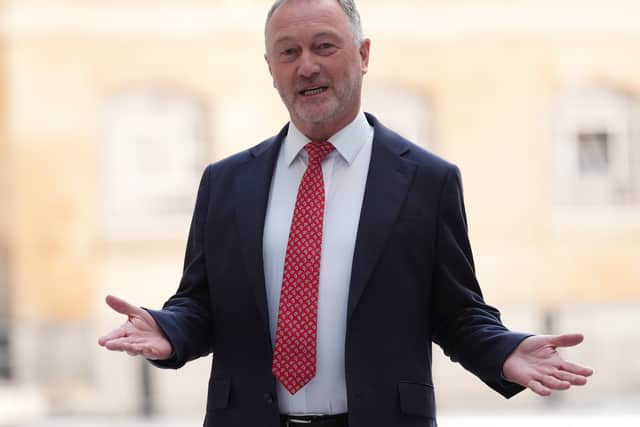
“These reforms create stronger, more efficient councils that lay the foundations for real devolution and the economic growth that will bring new jobs and opportunities to communities right across England.”
Comment Guidelines
Iconic Media encourages reader discussion on our stories. User feedback, insights and back-and-forth exchanges add a rich layer of context to reporting. Please review our Community Guidelines before commenting.