
'Hospices in the West Midlands are facing financial crisis - we must act now to save them' - Impassioned plea in open letter by charity boss
Hospices must be better funded by the NHS if they are to survive, with guaranteed support to allow them to care for patients in their time of need.
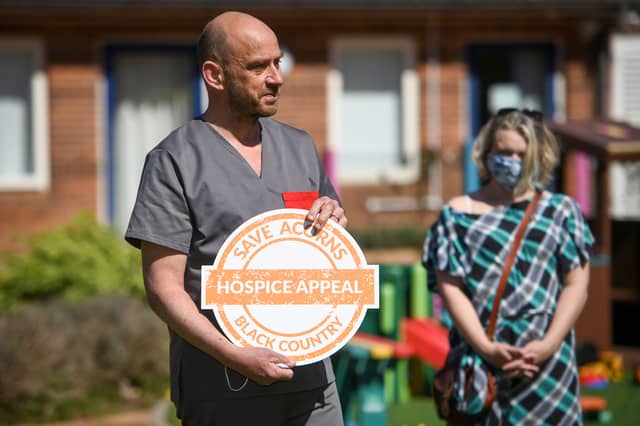


That is the demand today from Toby Porter, a former boss of Acorns Hospice who is now in charge of Hospice UK.
Mr Porter today writes for the Star to raise his fears for hospices in our region as they are forced to deal with repeated financial pressures.
The organisations provide vital palliative care both at their centres and in the community, offering vital medical help and support to families.
But they are not given a sustained or regular income from central government, instead having to rely on short-term grants that do not allow them to plan for the future.
And there have been many cases of hospices running short, with recent redundancies at St Giles Hospice in Lichfield.
The Express & Star and Shropshire Star have both campaigned for a change with its Fair Deal for Hospices Campaign.
Mr Porter was in charge of Acorns Hospice in 2019 when it found a £2 million hole in its finances. It announced the closure of its Walsall hospice, but an appeal was successful in saving it and it continues to care for sick children with life limiting conditions.
Mr Porter's message comes as official figures show hospices have been forced to cut back services for people who are dying due to multimillion-pound funding deficits. The National Audit Office says nearly two thirds of independent hospices in England reported a deficit in 2023/24. At the end of 2024, around 300 inpatient beds were “deregistered or withdrawn from operation”, the report states, though some of these could have been due to a preference for being cared for at home.
Experts said the report highlights the “inconsistency and insufficiency” in how hospices are funded. In 2023/24 around 29 per cent of income for hospices was through Government funding. Most income for hospices is generated from charitable sources, such as charity shops and donations, according to the NAO report.
An open letter by Toby Porter, Chief Executive of Hospice UK:
I first had the privilege of speaking to the readers of the Star in 2019 when I was Chief Executive of the wonderful Acorns charity. It was their incredible generosity that helped save the Acorns Children’s Hospice in Walsall from closure in 2019, when the charity faced a funding crisis.
It remains one of happiest memories and most important achievements of my career, that the Walsall hospice continues to this day to serve the children and families in need across the West Midlands, and is so well loved and well supported with that vital task by their local community.
I left Acorns in 2022 to join Hospice UK, the national charity for all the adult and children’s hospices. This allows me to continue to follow Acorns, but also the wonderful adult hospices that serve your community, such as Compton Care in Wolverhampton, Mary Stevens in Oldswinford, St Giles in Lichfield, and Birmingham Hospice in Sandwell as well as Shropshire organisations such as Severn Hospice and Hope House.
Sadly, as you may have heard, most of these hospices are facing huge financial challenges. I sadly know all too well from my time at Acorns when hospice services are well funded and when they are not.
Today, I want to speak honestly: the financial model for hospices is failing.
With rising demand for our vital services due to our ageing population, as well as rapidly rising costs, we can no longer rely principally on fundraising and charity shops to pay for the end-of-life and palliative care that our communities need.
If the Government and the NHS don’t act now and commit to properly funding hospices, the consequences will be profound not only for the sector, but for patients and families who rely on hospices’ vital services.
Hospices are a key part of our healthcare system. Whether in inpatient units or people’s homes, they relieve suffering, support families and help people live well until the end of life.
Currently they depend overwhelmingly on the generosity of fundraisers in local communities. Since April last year, 20 hospices have made major cuts, including St Giles and Birmingham Hospices.
Our surveys at Hospice UK tell us that two in five hospices across the country are planning reductions in the year ahead.
The Government’s 10-Year Plan for Health sets out a clear ambition to shift more care into people’s homes and communities, which is exactly where hospices excel.
Hospices are already delivering expert palliative and end of life care outside hospital settings, making them the natural partner for this transformation. With the right funding, they can play a central role in achieving the goal of community-first care.
That’s why Hospice UK is now calling for fundamental reform with our four-point plan for fair funding. It is:
1.Funding
We want full funding of specialist palliative care provided by hospices Whether in inpatient units, in patient’s homes, in outpatient clinics or through in- reach services within hospitals, the specialist palliative care, advice and assessment hospices provide should be fully funded by local NHS commissioners.
2.NHS contracts
There should be proper NHS contracts for hospices Too often, the state’s contribution to the cost of hospices’ services are through grants which don’t reflect the true cost, and which are based only on historical precedent. Hospices should be on NHS contracts which are fair, multi-year, have regular reviews and increase in line with rising costs. These should be based on agreed, national cost models. Contracts should be flexible in response to the changing care needs of a local population and meeting rapidly growing demand.
In addition, the government should continue to provide ringfenced additional funding for children’s hospices (formerly known as the Children’s Hospice Grant), over and above local contracts, recognising the large areas covered by these services.
3. Funding for hospice staff
When pay deals are agreed for NHS staff, hospices must receive the funding needed to give their staff a pay rise too. Right now, they don’t – leaving hospices to plug the gap with already limited funds.
4. Equal care
There should be national accountability for equitable provision of palliative care, wherever you live
These changes would stem the wave of cutbacks to hospice services we have seen in the past two years. They would open up significantly more community palliative care capacity to underpin the government’s vision for neighbourhood-based care – allowing hospices to better meet the growing needs of our ageing population. And they would help guarantee, as a critical safeguard in a future assisted dying service, that good quality palliative care was available for all who need it.
Let me be clear: this is not about asking for more charity fundraising - it is about recognising that hospice care is a vital part of our healthcare, and that the government must fund it properly. It is not fair that whether a person receives hospice care depends on a person’s postcode or how successful their local hospice is at selling raffle tickets. While the recent £100m capital funding grant from the government, announced last December, was welcome, it alone cannot plug the gaps in day-to-day specialist care delivery and workforce sustainability.
We must act now. Hospice services should be recognised as an essential part of the health system, and the skilled workforce that delivers this care must be treated on equal terms with their NHS counterparts.
Reforming how hospice care is funded and commissioned is vital to achieving the ambitions set out in the Government’s 10-Year Plan for Health - to move more care into homes and communities, and to give people choice and dignity at the end of life.
Our four-point plan would make this possible. Hospices are ready to help deliver this transformation, but they need sustainable, long-term investment to do so.
With the right funding, we can deliver hospice care for all who need it. But the time to act is now.
Comment Guidelines
Iconic Media encourages reader discussion on our stories. User feedback, insights and back-and-forth exchanges add a rich layer of context to reporting. Please review our Community Guidelines before commenting.