
'I'm slowly losing him': Wolverhampton couple's story lays bare cruel impact of Alzheimer's disease
"I'm slowly losing him, but more importantly he is losing his sense of self."
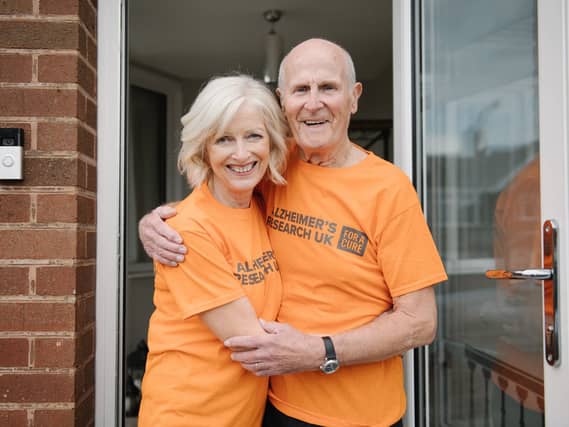


Those are the heartbreaking words of a Wolverhampton woman who is gradually losing her husband of almost four decades to a cruel degenerative disease.
Frank Littleford, who is Wolverhampton born and bred, is among the hundreds of thousands of people living with dementia in the UK.
The 78-year-old, from Penn, worked as a probation officer for 40 years before he was diagnosed with Alzheimer's disease in January 2020.
Sharing his story is Frank's wife of 38 years, Alison, who encouraged him to visit the GP five years ago when he was initially diagnosed with depression.
She said: "Frank was diagnosed with prostate cancer in 2015 and successfully treated for that, and it was shortly after that I began to notice slight changes.
"Things that I would have expected him to be able to do or remember, he was beginning to struggle with. Not only forgetting names, but forgetting perhaps how to operate things like garden equipment and occasionally not recognising where we were in very familiar surroundings.
"Frank, through all of his career, was a probation officer. He was used to writing complex court reports, standing up and discussion situations so cognitively. He was very sharp, and then it began to change a little bit and I became quite concerned.
"Dementia is going to affect one in two people in some way, either for looking after a loved one or having it themselves or both. It's unlike a lot of diseases in that the losses are multiple and for Frank, fortunately he isn't as ill as some people are - but I'm slowly losing him, but more importantly, he is losing his sense of self which is incredibly sad.
"It strips away the confidence and the competence of people so that they are losing so much of their ability to do things and understand things. It's not a massive decline, it's a slow drip effect, it's forgetting how to use the coffee machine, forgetting how to operate the lawnmower effectively and that's so distressing to him - forgetting the names of your grand-children, that's just heartbreaking to him."
Frank has been part of a medical drug trial led by Join Dementia Research for the past two years, playing his part in helping to find a cure for the disease that has stripped the independence of so many.
The couple are also both volunteers for the media and communications team for Alzheimer's Research UK, with Frank having recently taken to social media in a video campaign to share his story.
Speaking in the video, Frank said: "A cure would help others not to have the fears that I've had, not to have the pain that I've had and live longer, happier, fulfilled lives."
It is not just those who are living with Alzheimer's that are affected by the disease, but also their friends and families.
Alison, 70, added: "I suppose I've had to adapt. I might have said 'what would you like for tea' but he can no longer answer that so I say 'do you want beef or chicken' – he can't make those big decisions now, if I give him too much information in one go, he just can't make sense of it.
"If I go out on my own or whatever, I never go out with a free and easy feeling, in the back of my mind I think 'is he okay?' I just have to always think ahead so it's harder to be spontaneous now.
"He's got a great sense of humour, he would have been the life and soul of the party before dementia affected us. He's interested in other people, socialising, gardening, theatre and cinema – we still do those things but he struggles to follow it."
Now, Frank regularly attends various memory groups in the city, including one hosted at Molineux Stadium, home to his beloved Wolves.
Helping to lead the fight against the disease is Alzheimer's Research UK, who have invested more than £750,000 in 17 projects across research institutes in Birmingham, Warwick and Worcestershire to date.
David Thomas, head of policy of access and innovation at the research charity, said: "It is people who are living with dementia, like Frank, who are spurring us on to find a cure for the diseases that cause it.
"We are so grateful for Frank and Alison's support and their involvement in dementia research. Without them and people like them, progress in this area would not be possible.
"We need to deliver life-changing treatments for everyone affected by dementia, revolutionise how it is diagnosed and find ways to prevent it altogether. But we cannot do this alone. That's why we're urging people to stand with us and join our search for a cure."
To support the charity in its life-changing research, visit alzheimersresearchuk.org/.
Comment Guidelines
Iconic Media encourages reader discussion on our stories. User feedback, insights and back-and-forth exchanges add a rich layer of context to reporting. Please review our Community Guidelines before commenting.