
From circus ground to shopping centre: My memories of Birmingham’s Big Top
The ‘Big Top’, bounded by New Street, High Street, Union Street and Union Passage, is especially significant, writes Dr Steven McCabe
One of the experiences I recall with joy is the period when my mother worked in the Co-op in the mid-1970s.
Because she finished at 6pm when the restaurant closed, I used the opportunity to go into Birmingham for a couple of hours and mooch around the shops and explore what was available.
Unsurprisingly, Birmingham has altered significantly in the last half a century.
Many buildings have been swept away in the relentless quest for progress so characteristic of the city.
However, reassuringly, many remain.
One, built in the late 1950s, is especially significant.
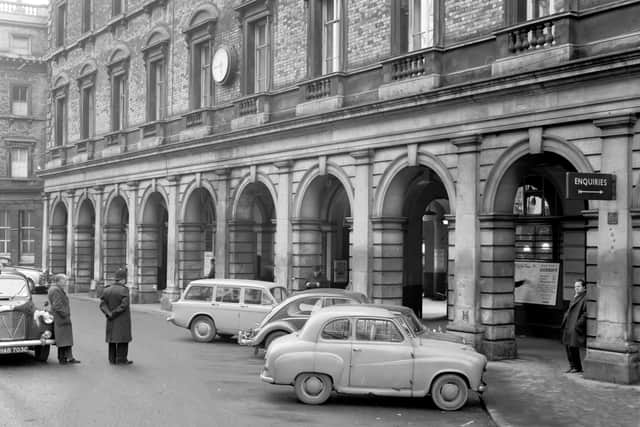

This is what’s known as the ‘Big Top’, which is bounded by New Street, High Street, Union Street and Union Passage.
The name of this development, resulting in the city’s first ‘shopping centre’ and a thirteen-storey block, City Centre House, which became Birmingham’s highest office building, having become a vacant site as a result of Luftwaffe bombing overnight on 9–10th April 1941, is being used for circuses, which used a large tent for many years after the Second World War.
The bombing raid on the city centre was especially intensive when, it was estimated, over 200 planes dropped in excess of 650 high-explosive bombs and 170 incendiary devices and resulted in the destruction of a number of buildings and Midland Arcade, which ran through the site; the only part to survive and which still exists is City Arcade, located between Union Passage and Union Street.
Those buildings not immediately destroyed by bombs were subject to intense fire caused by incendiary devices which burnt out their internal wooden structure of floors and roofs, leaving their exquisite and wonderfully ornate Victorian facades standing precariously.
Any sentiment about the loss of buildings during the war was, understandably, far outweighed by death and injury suffered by civilians and emergency workers.
It’s worth remembering that the 77 air raids Birmingham experienced, carried out by the Luftwaffe, killed 2,241 of the city’s residents and resulted in 3,010 individuals suffering severe injuries, with 3,682 others sustaining lesser injuries.
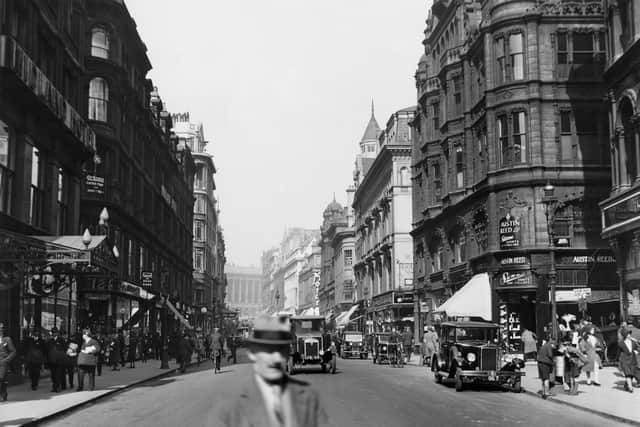
All that citizens of Birmingham could do, like those who experienced the Luftwaffe in other parts of the country, was to remain stoical about the privations being endured and, after clearing up the rubble created by bombs, to continue ‘normal life’ as best they could and remain optimistic that there would be a better future once hostilities ended.
Given that there were still another four years before the war with Germany finally ended, it meant that the bombed site on New Street/High Street remained vacant until peace allowed consideration of what would replace what had been a valuable part of Central Birmingham.
However, though the war with Germany ended in 1945, restrictions on the use of resources for rebuilding the 12,391 houses, 302 factories, and 239 other structures destroyed in Birmingham took priority.
As a consequence, the ‘Big Top’ site remained a flat site in the centre of Birmingham for a decade after the war and, when not being used as a car park, provided a venue for circuses which set up each year.
These circuses allowed many thousands to spend a couple of hours in the centre of Birmingham and enjoy the excitement and thrills of being entertained by an array of performers consisting of trapeze and highwire acts, acrobatics, clowns, the human cannonball, those displaying strength, fire-eating, jugglers, and magicians.
As was absolutely common back in the 1940s and 50s, animals were a standard component of any circus and would include horses, monkeys, dogs and more exotic creatures such as elephants and what were commonly referred to as ‘big cats', such as lions and tigers, who were ‘tamed’ by a brave trainer.
In my research I’ve come across a report that during one circus one of the employees was mauled to death by a tiger in front of a large crowd and that 'many newspapers of the time described [the death] as "a sight no one deserves to see, not even the most wicked".' ”.
I’ve not been able to verify whether this report is accurate and when it was supposed to have happened, but I’d speculate it hastened the end of ‘Big Top’ performances in the centre of Birmingham.
Undoubtedly, the city council were keen to see a site that had been vacant for so many years developed.
Thus, in June 1954 it was announced that developer Cotton, Ballard & Blow would invest five million pounds (worth almost £180 million now) to build a shopping centre and to revive “the once familiar arcades” that had been a feature of Birmingham’s city centre since opening in the early 1900s but, sadly, were mostly lost as a consequence of the bombing in April 1941.
Construction on the Big Top site commenced early in 1955 and took three years to complete the building of the shops, which opened in 1958 and are three storeys above street level at the intersection of High Street and New Street and six storeys on some of New Street and on Union Street.
Completion of the thirteen-storey office block, which fronts onto Union Street, was not completed until 1959.
Birmingham citizens eager to see what the building would actually look like had to wait some time before construction of the shops started.
This was due to phenomenal excavation being required to create an extensive undercroft (underground level) which formed a hidden labyrinth allowing deliveries by lorries and vans to shops and was accessed via a service road from the Inner Ring Road, and which can still be seen at the back of Primark and the former Marks and Spencer building.
I can vouch for how impressive the underground world under the Big Top is, having driven into it when making a collection of a large item by car from the Mothercare shop (long gone) back in the early 1990s after the birth of my son.
Fascinatingly, one of the first tenants in the Big Top office block was the Ministry of Defence.
It’s believed their primary role was to oversee the construction of a nuclear fallout shelter underneath the office block with tunnels all linking it to the Council House.
This would enable key officials to relocate to the safety of shelter and, after any nuclear strike, likely to kill the majority of Birmingham’s citizens, and to oversee vital services in the absence of functioning statutory authorities.
Notably, and though I am uncertain about this, I believe the tunnel linking the two Co-op stores on either side of High Street, one of which was destroyed in the April 1941 bombing and to which the entrance to the restaurant my mother worked in was probably constructed, was probably constructed this time.
In referring to the Co-op, I’m conscious that the fact that a store which was as dominant as this was willing to open a store to replace the one lost in the April 1941 Luftwaffe raid – it owned the freehold of the site of its former store, giving it huge power to negotiate – as well as the desire of the British Home Stores (BHS) store to open a large store influenced the planning of the shopping centre.
Any desire for the arcades created within the building, which were accessed from High Street, New Street and Union Passage (beside where the post office used to be located), meant there would not be the plethora of smaller independent shops in them, as would have been the characteristic of those destroyed in the bombing.
However, such concerns would have been overwhelmed by the sense of euphoria generated by a new shopping facility when it opened.
That it was modern and not a patch on the gothic buildings destroyed 17 years previously by German bombers would have been unimportant.
Birmingham was showing its desire to become a modern city and embracing the future with both hands.
However, within five years there was an even newer shopping centre almost literally a stone’s throw away in the form of the far larger Bull Ring.
The Bull Ring boasted far more shops, an integrated car park where, initially, you dropped it off and it was parked for you, pubs, restaurants and cavernous open space which must have had the longest escalators ever installed in the city!
A few years later in 1968, with the development of New Street Station and shopping centre built above, originally called the Birmingham Shopping Centre, you could walk under cover from there across the bridge to the Bull Ring without having to worry about what the weather was doing (though some felt not being subject to the elements was not natural).
Perhaps, it might have been suggested, the Big Top was though within sight of these newer choices for shopping.
Nonetheless, during the 1960s and 70s, all three co-existed, and the attraction of the Co-op, BHS and W.H. Smith, which occupied a large amount of space and could be accessed from High Street, Union Street or the arcade opposite the post office, was still sufficient to create sufficient footfall.
BHS’s store, at ground level, was divided in two by the arcade running through the Big Top.
This meant that general goods were in the part of the store facing onto New Street, and the other, a food hall, faced onto Union Street.
The basement of BHS had a cafeteria, which I recall my mother taking my two younger sisters and me to for fish fingers, chips and beans as a treat when we’d been shopping in 'town', as people usually referred to Birmingham city centre.
Sadly, the 1980s heralded a sense of brought decline in the fortunes of the big top.
The Co-op, which had always seemed to have become locked into the 1950s, closed down to be replaced by Mothercare in the Big Top, and the building on the other side, which had been built in 1914, was knocked down and replaced by the Pavilions in 1987, the latest shopping centre.
This, sadly, meant the tunnel under High Street between the two stores became redundant and, I’m reliably informed, was sealed off and will, perhaps, become an archaeological curiosity if discovered by accident in, say, a couple of hundred years.
As an unnamed commentator writing for the Birmingham Architectural and History website in May 2007 asserted, aesthetically and architecturally, it “is nothing… a catastrophe", and the arcades are too dark and reliant very much on light from the shop windows, as there was no daylight through windows in the roof as was the case in the arcades lost in 1941 (and can be seen in the City Arcade off Union Street).
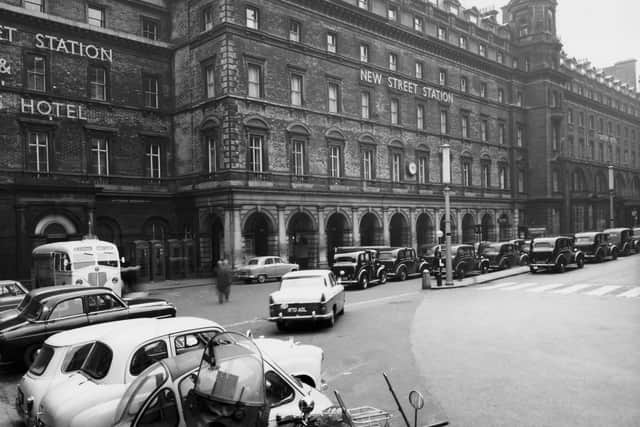
This continued shopping by walking within the arcades was about as appealing as going down a mine shaft!
Lack of footfall and reduced investment in a building which, by the end of 1988, had been open for 30 years meant the Big Top was no longer a must-visit destination for shoppers.
Consequently, there has been a regular turnover of tenants and the loss of other key tenants, including BHS, which closed in 2016 to be replaced by H&M and then Primark, which, in 2019, moved to the former Pavilions shopping centre.
Significantly, though the Big Top may have experienced decline and its future is uncertain, it’s proved to be a stubborn survivor.
The new shopping centre of the 1963 Bull Ring has been demolished and replaced by a newer version.
The Pallisades, which is what replaced the Birmingham Shopping Centre above New Street Station, has undergone tremendous change, especially in the conversion the station underwent to become Grand Central, and is effectively no longer a shopping centre.
The Pavilions, which replaced the Co-op building in which my mother worked, has been completely revamped to become the largest Primark in the world.
Given increased shoplifting as well as the desperately tragic sight of homelessness and rough sleeping in Birmingham, it’s no surprise the arcades, intended to replace the gorgeous Victorian ones lost in 1941, have been sealed off, and it’s no longer possible to take short cuts through the Big Top.
And whilst many of the retail units in the Big Top are in use and have viable tenants, there’s no mistaking the fact that there are vacancies, particularly on Union Street.
Indeed, as we all know, online retailing has proved to be an existential challenge to all retailers, though there will always be demand for physical shop units rather than those that are virtual.
Evidence produced by property analysts CoStar shows that in the last two years the total amount of retail space has fallen as retailers retreat from the high street.
Which, finally, begs the question of what should we expect as to Big Top’s future?
There’s no argument that though Big Top's location makes it attractive, there is no immutable law meaning it will always be a shopping centre.
The fate of the thirteen-storey office block vacated five years ago by HMRC, which used to occupy a number of floors and is awaiting refurbishment to another use, such as accommodation, demonstrates that change of use is usually the only way to survive and avoid demolition.
In many ways, and despite criticism of the aesthetic merits of the Big Top, the fact that it’s been an integral part of the city for so long when so many more recent other post-war buildings have survived suggests it should be applauded for still being here.
Nevertheless, it’s inevitable that further transformation may be necessary as the requirement for retail space shifts.
Perhaps, in the future, the Big Top may even be converted to housing and associated leisure facilities.
Live entertainment would recapture the heady days when the Big Top site hosted circuses.
What’s so desperately sad is that when the site was being developed back in the 1950s, more thought was given to trying to rebuild what was destroyed by Luftwaffe bombers, in exactly the way that Germans were resolute in recreating buildings lost there as a result of RAF bombing.
If Big Top is ever replaced, we should demand buildings with ornate brick facades standardly constructed a century ago, albeit with modern interiors that would be essential for new tenants.
This would be architecturally pleasing and help to make Birmingham more attractive to shoppers and visitors to the city.
Sadly, I acknowledge that's so radical as to be considered ridiculous.
In the meantime, next time you pass the Big Top, spare a moment to think about its long and fascinating history.
Comment Guidelines
Iconic Media encourages reader discussion on our stories. User feedback, insights and back-and-forth exchanges add a rich layer of context to reporting. Please review our Community Guidelines before commenting.