
New report into major canal collapse reveals 'likely' causes of disaster which left boaters homeless

The trust also warned repairing the canal could take most of this year.
The trust which owns the Llangollen Canal has said a severe embankment collapse at Whitchurch which left a number of boaters homeless was likely caused in part by “slow, low-volume leakage under the canal bed over many years”.
The Canal & River Trust revealed the findings in a preliminary report from the investigation into the cause of the disaster days before Christmas.
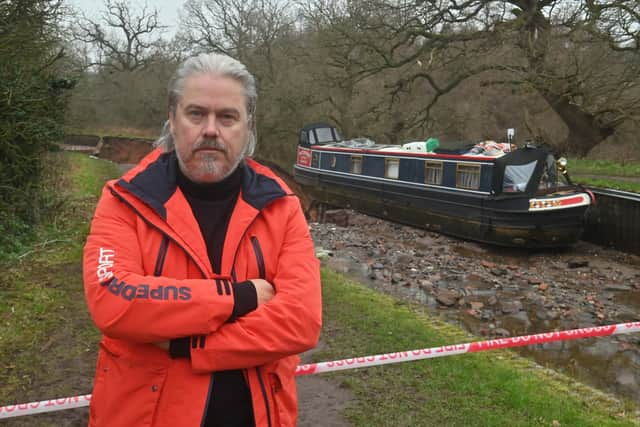
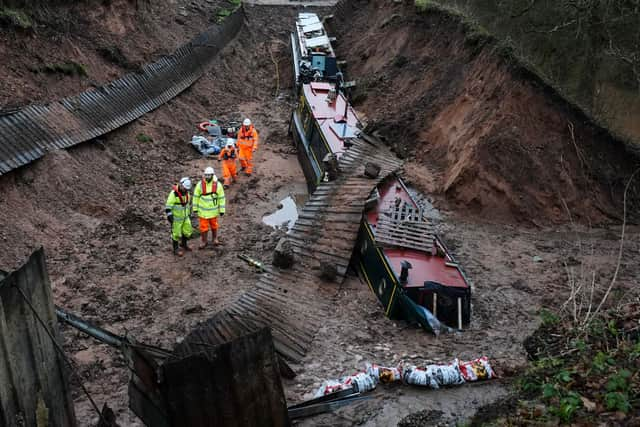
The massive collapse in the Chemistry area of the town in the early hours of December 22 sent an estimated 100 million gallons of water from what was the canal into a neighbouring field, also sucking two narrowboats into the breach, leaving a third perched on the edge of the giant hole that had suddenly opened up and stranding others on the bed of the drained canal.
Emergency services declared a major incident and fire crews evacuated at least 10 people from boats. Although nobody was seriously hurt in the collapse, the owners of the boats were rendered homeless until their vessels were rescued over the course of the following month. One boat has since been written off.
The Canal & River Trust, which owns and is responsible for maintaining the waterway, has been preparing to rebuild the damaged Whitchurch Embankment 2 and fill the canal with water, but it has also been investigating what caused the collapse.


Today (March 31) the trust has released a report of its findings so far, including the likely causes and a number of “interim recommendations and actions [...] which the trust is taking forward with immediate effect”.
The report described the collapse as “an extremely rare but serious incident that has resulted in closure of the canal and towpath until repairs are complete”.
In its introduction the report said: “The trust recognises that the breach [...] was a deeply distressing and frightening experience for those directly affected and caused significant disruption and uncertainty for boaters and nearby residents. We are deeply sorry for the impact this event has had on individuals, families and the wider community, and we recognise how challenging this has been for those affected. “
It also acknowledged emergency service crews and first responders “whose swift and professional response ensured that everyone was brought to safety” as well as ”the calm and prompt actions taken by those at the scene” plus “the boating community and local residents for their continued patience and cooperation throughout the response, recovery works and ongoing investigation.”
“The investigation is ongoing at the time of writing. It aims to identify the possible cause(s) of the breach and whether it could have been predicted by the trust’s procedures. The conclusions of the investigation will be used to inform improvements to future maintenance and inspection regimes. Its ultimate purpose will be to improve canal infrastructure resilience by identifying features of the incident that may have contributed to the embankment failure, and whose identification could help to mitigate the risk of similar incidents elsewhere.
“This report is based on initial analysis only; the full investigation requires additional site investigation and inspection which will be completed in the coming months, once those parts of the site still submerged beneath breach debris are cleared. A final report will be issued once the investigation is complete, which is expected later this year.”
It continued: “The breach occurred on Whitchurch Embankment 2, a high, steep, curved embankment with visitor moorings. Prior to the breach, it had not been classed as an asset of concern or at risk of breaching. It had been regularly inspected in accordance with the trust’s standards, which include a robust inspection regime; no evidence suggested imminent collapse.
“Despite the absence of visual indicators, failure of the structure progressed over a short period of time, with no opportunity to intervene. Boats present at the location were drawn towards the breach and several boaters were displaced; a large volume of water drained from the canal onto adjacent farmland.
“The initial and still ongoing investigation, led by a trust principal engineer, has explored all plausible contributory factors and delivered its early findings. It suggests the failure was likely caused by a combination of specific physical factors in this location: a steep-sided, very high embankment predominantly constructed of sand, together with suspected slow, low-volume leakage under the canal bed over many years.
“This long-term leakage, or ‘piping’, is thought to have eroded material below the canal bed and created a void, ultimately resulting in collapse. The trench sheet pilings that had protected the bank dropped when the void expanded.
“Based on the information currently available, no material evidence has been identified to suggest that any of the following could have caused the breach: heavy rainfall, high water levels (overtopping), badger or rabbit excavations or unexpected tree falls. The condition of adjacent assets is also thought to be unlikely as contributory factors; however, two nearby culverts will be examined more fully when site conditions allow.”
The report set out some of the recommended actions arising from the findings.
“Initial actions include identifying other locations where a comparable combination of characteristics may exist and undertaking any additional checks considered appropriate, exploring new techniques to detect sub-surface erosion, and reviewing the risk assessment six regimes for earth structures. Further investigation and assessment are likely to suggest more actions and recommendations.
“Given the extent of the damage to the embankment and the number of potentially interacting factors, it may not be possible to identify a single definitive cause.”
Campbell Robb, Canal & River Trust chief executive, said: “The breach at Whitchurch was a distressing and frightening experience for all those affected. We remain deeply sorry for the impact this event has had on boaters and the wider community and once again I’d like to thank all who responded so swiftly and generously when this event happened. We are committed to repairing the canal and reinstating navigation as soon as we can do so safely.
“While breaches of this scale remain extremely rare, we are already taking forward a number of recommendations from the investigation. We have a comparable inspection regime to organisations looking after similar infrastructure but we are augmenting this, including exploring different methods of geophysical surveying technology to better inspect beneath canal beds.”
The trust said the repair of the canal is likely to take most of this year. It will include completing a 100-metre-long access track across farmland from the A41 which will be used to bring in 20,000 tonnes of aggregate to rebuild the embankment. A spokesperson said “construction is likely to start this spring once in-depth ground investigation works are complete”.
View the full report at https://canalrivertrust.org.uk/about-us/where-we-work/west-midlands/llangollen-canal-breach.
Comment Guidelines
Iconic Media encourages reader discussion on our stories. User feedback, insights and back-and-forth exchanges add a rich layer of context to reporting. Please review our Community Guidelines before commenting.