
Who Put Bella In The Wych-Elm? Unravelling the mystery of murdered woman's skeleton found in tree trunk
A human skull with fragments of old flesh and strands of brown hair stared out at four young boys.


They had made an unbelievably gruesome discovery inside a tree trunk – and the murder mystery that followed has never been resolved.
The four friends Robert Hart, Thomas Willetts, Bob Farmer, and Fred Payne had wandered into Hagley Woods on Lord Cobham's private estate in the hope of poaching bird nests.
It was in the middle of the afternoon of Sunday, April 18 in 1943 when the large Wych Elm tree caught their eye. Robert attempted to climb the bark when he spotted a large hole in the hollow of the tree.
Being curious to know what was inside, Robert peered in and spotted what looked like a skull of some kind.
Using a stick to prise it out, the boys made the horrific discovery. A human skull, with fragments of old flesh and strands of brown hair, staring back at them.
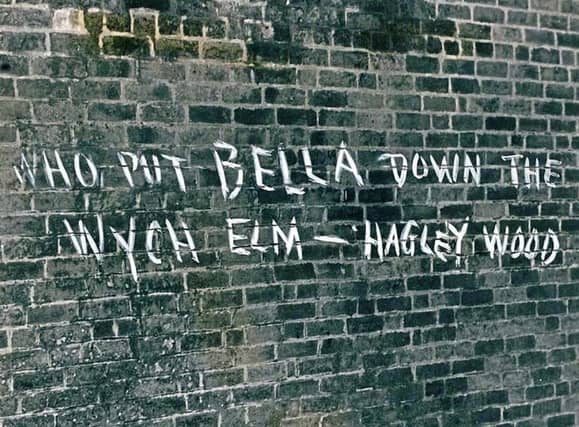
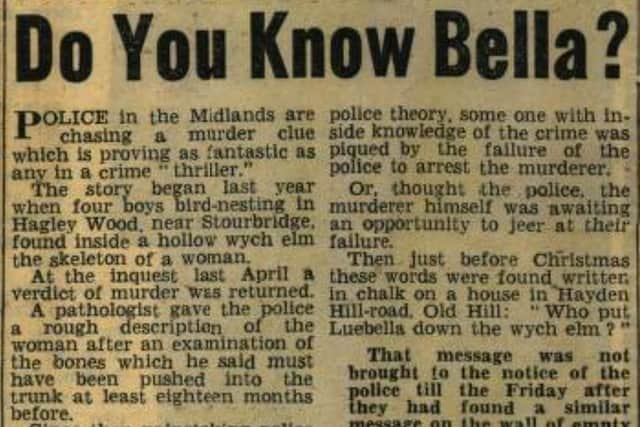
In 1944, graffiti related to the mystery appeared on a wall in Upper Dean Street, Birmingham, reading: "Who put Bella down the Wych Elm – Hagley Wood."
This provided investigators with several new leads for tracing who the victim could have been. Other messages in the same hand appeared too. Since at least the 1970s, similar graffiti has sporadically appeared on the Hagley Obelisk near to where the woman's body was discovered, which asks the slightly modified: "Who put Bella in the Witch Elm?"
The discovery and subsequent graffiti sparked the start of a national news story that has gripped the nation, and the headlines ever since, with just one question: Who put Bella in the Wych Elm?
Many theories have emerged over the years, ranging from espionage to witchcraft. In 1953, an Express & Star reporter received a handwritten letter signed by Anna, who claimed to have known what had happened to Bella and who she was. The Express & Star even promoted a reward of £100 to help catch the culprits.
However, despite all of the leads and extensive efforts by police, the identity of the woman and the circumstances surrounding her death remain a mystery.
Keen historian and self-professed ‘history influencer’ Sarah Haywood, who works as a teaching assistant at Brierley Hill Primary School, has been researching Bella and shared her finds from the British Newspaper Archives with Express & Star readers.
Sarah, a mum-of-two who runs the West Midlands Historic Chronicles - The Black Country and Beyond Facebook group, said: "After finding the skull, a wave of panic set among the boys, how could they tell anyone of their discovery? They had been on the land illegally and the thought of getting in trouble for that plagued them.
"The boys quickly placed the skull back, promising each other never to tell anyone about their findings.
"After returning home, one of the boys mentioned the traumatising finding to his father, who then called and told the authorities of his son's discovery."
From 1941 to 2024: Investigation into murder of Bella remains unsolved
When police arrived they discovered an almost complete skeleton. It had a blue shoe, gold wedding ring, and some fragments of clothing.
Valuable evidence remained intact including tufts of hair and had a clear dental pattern, despite some missing teeth. The remains of a hand were found some distance from the tree.
Birmingham-based Home Office pathologist James Webster quickly established that it was that of a female aged around 35 years old who had been dead for at least 18 months, placing time of death in or before October 1941.
Webster also discovered a section of taffeta in her mouth, suggesting that she had died from suffocation. From the measurement of the trunk in which the body had been discovered, he also deduced that it must have been placed there "still warm" after the killing, as it could not have fit once rigor mortis had taken hold.
They cross-referenced the details they had with reports of missing persons throughout the region, but none of them seemed to match the evidence - and the task was particularly tricky during the Second World War. Despite chasing several new leads over the years a case review by West Mercia Police was closed in 2014.
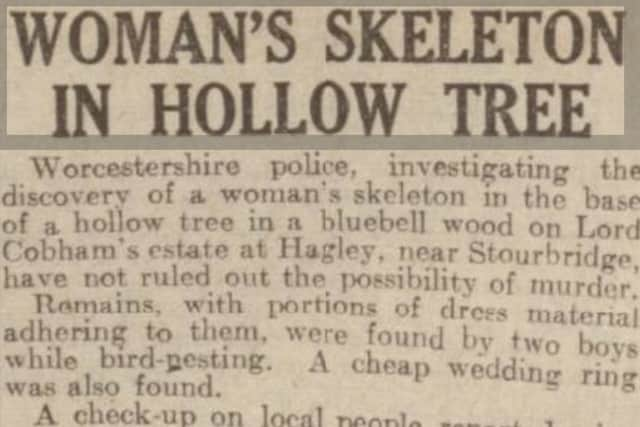
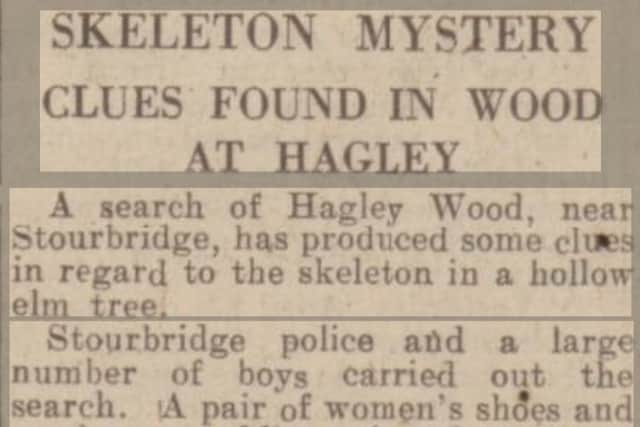
Newspaper headlines went crazy for Bella and the mystery surrounding her death.
One report said: "Riddle of Skeleton in a Tree. Worcestershire police are investigating the mystery of the skeleton of a woman found in the base of a tree trunk in a little frequented wood on Lord Cobham's estate at Hagley, near Stourbridge. The discovery was made by the boys who while bird nesting saw what appeared to be a heap of bones at the base. Portions of the dress material still clung to the bones. The tree stands in a BlueBell studded part of the wood about 125 yards from a private lane that leads to clent hills. The remains have been removed for inspection by Professor Webster of the West Midlands Forensic Science Laboratory." (Birmingham Daily Gazette, April 22 of 1943)
A snippet of an archive report stated: "Professor Webster told how he had the tree trunk opened out and had finally been able to reconstruct the skeleton, which was that of a woman probably about 35 years of age. There was no evidence of violence on any of the bones. He found part of a garment stuffed deep into the cavity of the mouth. That might have been the cause of death. He thought the skeleton had been in the tree for at least 18 months, maybe much longer. He could not, he said, imagine anyone getting into the tree voluntarily. The aperture came down from 24 inches to 17 inches." (Evening Despatch, April 29 of 1943)
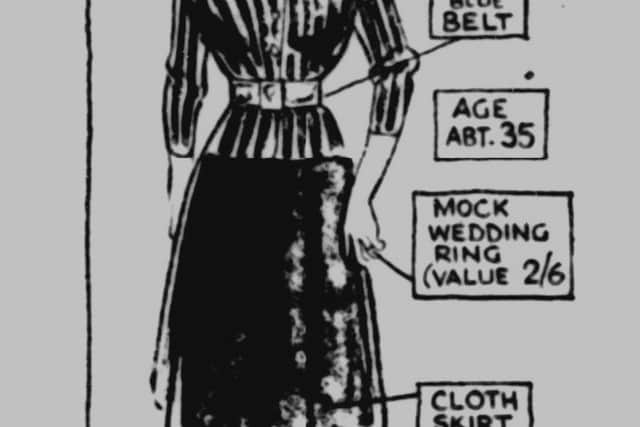
Sarah added: "It is believed the fabric belonged to a piece of her underskirt. Other items of clothing found on the skeleton were as follows - a dark blue knitted cardigan, peach taffeta underskirt, mustard-coloured cloth skirt with a blue belt, and blue crepe-soled shoes. I have listened online to a lecture by an historian who said these shoes were found to be sold on Dudley Market.
"The skeleton was only 5ft tall in height and had brown hair. Forensics noted irregularities in her lower jaw and front teeth. They searched every dentist's record to no avail."
An archive report said: "Teeth overlapped. The fact that only one tooth is missing from the right side of the lower jaw may have been a material factor in helping to trace the women's identity.
"An expert examination has revealed that the tooth may have been removed by a dentist and dentists are expected to refresh their memory in the hope of affording the clue. There were no fillings in the teeth, but there was a definite overlapping of the teeth in the lower jaw." (Birmingham Daily Gazette, May 4 of 1943)
After looking at the evidence, the verdict of murder was confirmed.
An archive article reported: "Murdered Women's Skeleton found. A verdict of Murder by person or persons unknown was returned by a coroner's jury at Stourbridge last night on the skeleton of a woman found in the hollow of a tree trunk at Hagley Woods, Stourbridge.
"Professor J.M.Webster Director of the Home Office Laboratory at Birmingham said the women could not have been pushed into the hole in the tree after rigor mortis had set in. She may have been killed nearby or brought from a distance by a car and put in the tree while the body was warm." (Daily Mirror, April 29 of 1943)
Mysterious graffiti sparks several new leads
In 1944, graffiti related to the mystery appeared on a wall in Upper Dean Street, Birmingham, reading "Who put Bella down the Wych Elm – Hagley Wood."
This provided investigators with several new leads for tracing who the victim could have been. Other messages in the same hand appeared too. Since at least the 1970s, similar graffiti has sporadically appeared on the Hagley Obelisk near to where the woman's body was discovered, which asks the slightly modified: "Who put Bella in the Witch Elm?"
Within days of the body being found, graffiti mysteriously appeared in public places, such as on the wall of Birmingham Marketplace and surrounding areas.
It was reported this chalking appeared on walls and empty buildings in Halesowen, Wolverhampton, Birmingham, and Old Hill.
An archive report said: "A new mystery chalk Mark appears. An unsolved Midland murder of a year ago is recalled by mysterious chalk writing that has suddenly appeared on the walls of buildings in Birmingham Fruit Market. A few days ago the following words were chalked on the wall of empty premises in Upper Dean Street, Birmingham - "Who put Bella down the Wych Elm, Hagley Wood?", the writing was too high up on the wall to have been done by boys and the police are inclined to view that of the work of someone coming into the city early in the morning with farm produce." (Evening Despatch, March 30 of 1944)
However, Sarah said: "Nearly 10 years after the above report, I found another article stating that the sprawling on the wall was found to be done by a crank. An article in the Birmingham Daily Gazette on November 28 of 1953 said: "Scrawl Clue Bella is False. One of the few clues in the 10-year-old mystery of Bella the woman found in a Wych Elm in Hagley Wood has proved to be false.
"Worcestershire police have traced the man, who a year after the skeleton was found, scrawled on the walls in Birmingham and Old Hill the words which gave her her nickname:- "Who put Bella down the Wych Elm, Hagley Wood? Dept. Supt Tom Williams, Head of the county CID said yesterday: 'It was the work of a crank who we are satisfied knew nothing and had nothing to do with the case.'
Conspiracy theories from witchcraft, espionage and the tip-off letter sent to the Express & Star
In 1953, an Express & Star reporter received a handwritten letter signed by Anna. From Claverley, she claimed to have known what had happened to Bella and who she was.
The letter which was published in the Express & Star read: "Finish your articles re the Wych Elm Tree by all means. They are interesting to your readers, but you will never solve the mystery. The affair is closed and involves no witches, black magic, or moonlight rites. The only clues I can give you are that the person responsible for the crime died insane in 1942, and the victim was Dutch and arrived illegally in England in 1941. I have no wish to recall anymore."
The woman who had written the letter was later traced by police. In 1953 Una Mossop stated her ex-husband, who was known as Jack had confessed – with his friend, a Dutch man named Van Ralt put her into the tree after she was drinking with them at the Lyttelton Arms Pub, Hagley.
"Bella" soon became very drunk and it was said she was to have passed out in the car that one of the men was driving.
The men allegedly claimed to have put her in a hollow tree in the woods in the hope that in the morning she would wake up and be frightened into seeing the error of her ways. Jack Mossop was confined to a Stafford mental hospital because he had recurring dreams of a woman staring out at him from a tree.
Sarah said: "However, he died in the hospital before the body in the Wych Elm was found. The likelihood of this being the correct explanation is questioned because Una Mossop did not come forward with this information until more than 10 years after Jack Mossop's death.
"The man confessed to putting her into the hollow of the tree and hoped upon her waking she would have been frightened. Could it have been a prank that had gone wrong? If they intended that, how could the cloth inside of her throat be explained?"
It has been suggested over the years that there were two possible victims. One possible victim was reported to the police in 1944 by a Birmingham sex worker. In the report, she stated that another sex worker called Bella, who worked on the Hagley Road, had disappeared about three years previously.
The name “Bella” (or “Luebella”) suggested the graffiti writer was probably aware of the identity of the victim.
Another theory comes from an MI5 declassified file about Josef Jakobs – the last man to be put to death in the Tower of London, on August 15 of 1941.
A report read: "An Abwehr agent, he parachuted into Cambridgeshire in 1941 but broke his ankle when landing and was soon arrested by the Home Guard. On his person was found a photo purportedly of his lover, a German cabaret singer and actress named Clara Bauerle. Jakobs said that she was being trained as a spy and that, had he made contact, she might have been sent over to England after him. However, there is no evidence that Clara Bauerle was parachuted into England, and several witnesses describe that Clara Bauerle was around 6ft (180 cm) tall, while Bella was 5ft (150 cm). In September 2016, it was determined that Clara Bauerle had died in Berlin on December 16 of 1942."
In 1945, Margaret Murray, an anthropologist and archaeologist at University College, London, proposed a more radical theory of witchcraft. She believed that the severing of one hand was consistent with a ritual called the Hand of Glory, after the victim had been killed during an occult ritual.
It was reported that her ideas excited the local press and led investigators to consider another seemingly ritualistic killing of a man, Charles Walton, in nearby Lower Quinton.
Sarah said: "While doing my research I have found links between the Wych Elm tree and what it symbolises. In mythology, Wych Elm trees were linked to the underworld.
"According to the Woodland Trust, they state: Elms used to be linked with melancholy and death. Elmwood was also traditionally used to make coffins. I started to read about Dr Murray."
In 1950, 80-year-old Dr Murray helped the police with their enquiries. An archive report in the Birmingham Daily Post in 1968 stated: "In their inquiries into the Lower Quinton murder, the police received help from a brilliant scholar who was also the leading authority on witchcraft not only in Britain but possibly in the Western World as well. Dr Murray went to lower Quinton to spend a week there."
She went on to record her views in an interview which was published in The Birmingham Post in September 1950. It read: "I think there are still remnants of witchcraft in isolated parts of Great Britain. I believe the dead woman here was another victim of devil worshippers."
Sarah added: "The theory about a man, who was the last person to be executed, in 1941 in the Tower of London, known as Josef Jakobs is intriguing.
"His lover was said to be a German cabaret singer and actress, Clara Baurle. He was said to have told people she had trained to become a spy, and that she had parachuted into England."
In 1953, another theory surfaced, namely that the victim was a Dutchwoman named Clarabella Dronkers, and she had been killed by a German spy ring consisting of a British officer, a Dutchman and a music hall artist, for "knowing too much". Available records and evidence were unable to support the story.
Sarah said: "Upon researching the surname Dronkers, I came across an interesting article in the archives. Jonathan Dronkers was a spy, trained by the Germans and was taught how to make and use invisible ink for sending messages."
The Liverpool Echo, 1943, article states: "Dronkers was picked up at sea posing as a Dutch refugee who had escaped the Germans. He later admitted that he had been trained by the German secret service as a spy, and had been taught how to make and use invisible ink for sending messages. Dronkers had been particularly instructed to get information on the strength and location of American and Canadian troops in England. He was executed at Wandsworth prison on December 30 of 1943."
Sarah said: "So who DID put Bella in The Wych Elm? Sadly, we still don't know - but maybe we could find out. Maybe there's a connection still out there. Who knows?"
Comment Guidelines
Iconic Media encourages reader discussion on our stories. User feedback, insights and back-and-forth exchanges add a rich layer of context to reporting. Please review our Community Guidelines before commenting.