
'Life in Dudley has been 40 years of hurt' - Mark Andrews on why his beloved town has been damaged by Merry Hill
November 27, 1990, was the date that I realised my home town may never be the same again.

I won't bore you with the reason the date sticks in my memory - it's really not very relevant. But I'll never forget what I saw. In the space of just over 14 months, a bustling town centre had been turned into the biggest flea market I had ever seen.
Sainsbury's had closed the previous summer, so there was little reason for anyone to venture up to the Trident Centre any more. The Cook's and Debenhams department stores had been closed for a while, the former a boarded-up eyesore, the latter was at least in partial use. But it was the market place where the real damage had been done. The former BHS and Littlewoods stores had both been converted into temporary-looking clearance stores, with next-to-nothing in them that the average person wanted to buy, and now it was the recently closed Marks & Spencer that had been turned into a giant purveyor of tatty lamp-shades and shop-soiled flat-pack furniture. The exodus to Merry Hill was almost complete.
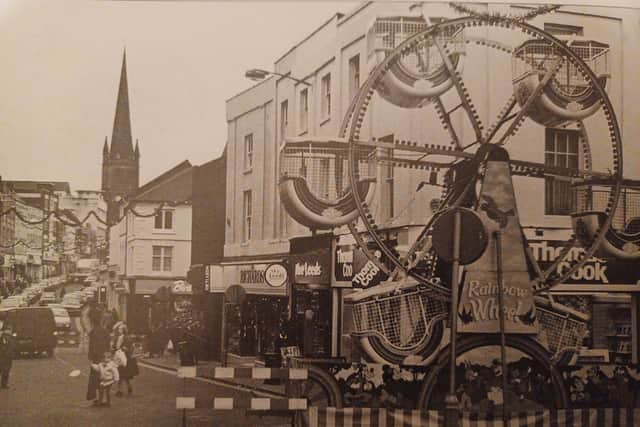
A few weeks later the council put on a funfair, in a half-hearted effort to draw people in, but the only thing it really achieved was to heap more ridicule on the town. The popular joke was that even Oxfam was looking to move to Merry Hill.

Up until that time, I had grown up in a town that had seen only optimism. The Black Country Museum had opened in 1976, and the following year Dudley had been shortlisted for city status - in those days candidates were chosen by the Government. In the end the accolade went to Derby, but it seemed inevitable that sooner or later Dudley would become a city.
In late 1990, it seemed hard to imagine how Dudley could sink any lower, and the years that followed did see a modest revival - for sorts. The junk hypermarket that had opened in Marks & Spencer eventually made way for a large branch of Wilko, which for a time established itself as the most successful branch in the country, and some years later, Sainsbury's became an early branch of B & M. A big step downmarket, but at least they served a useful purpose.
Over the past 40 years, there have been countless plans to revive the town, but they have all ultimately come to nothing. The most exciting scheme came in 1988, before the Merry Hill exodus had taken hold, with bold plans to extend what was then the Churchill Precinct, replacing it with a large modern shopping centre that would have extended as far as the Flood Street car park. It was turned down on the basis that it might spoil the view of the castle. Then, in the mid-1990s, Sainsbury's expressed and interest in building a large supermarket in Flood Street. It came to nothing. A few years after that, the Richardson group - the company behind Merry Hill - lodged an application for a retail park in Flood Street. It was rejected on access grounds. One can only wonder what might have been, had councillors not been so pernickety.
As recently as a decade ago, a company called Avenbury Properties put forward proposals for a major retail development on the site of the former Cavendish House office block. But the plan dragged out for years, by which time the bottom had fallen out of the high street retail market. Thirty years after Cavendish House closed, the site remains undeveloped.
Indeed, it could be argued that Dudley's failure to adapt are as much part of the town's fall from grace as the impossible competition a couple of miles up the road. When major retailers demanded glass-roofed shopping malls or large-format, warehouse style shops, council planners fretted about medieval street patterns and views of the castle. As Britain entered the Millennium, Dudley was - and still is - firmly rooted in the 1950s, with hundreds of outdated, cramped shops, which none of the big chain-stores will touch.
Then there was Dudley Council's own decision to strip the town of its strategic planning status in 2008, which effectively institutionalised its decline, making it much more difficult for any future developer to invest in retail regeneration. It's just another example of managed decline and expectation management. A town which no longer seeks to compete with the major players, but has decided to step down a couple of divisions instead.
Even the supposed £1 billion worth of investment that we're told is going to the town is steeped in managed decline. The glossy new bus station which opens this year will be smaller than the old one, which of course, had been built when Dudley was still a town on the up. The town's branch of Farm Foods was demolished to make way for it; not exactly Fortnum & Mason, I'll grant you, but it's now one less shop to come into town for.
Proposals to reopen the railway link were shelved when it was decided to use the track for the Metro tram system instead. Will the much-delayed tram link, which is due to open imminently, really be the silver bullet that kick-starts a change in Dudley's fortunes? I so hope I am quickly proved wrong, I'd be really happy to be left with egg on my face, but my fear is it will simply make it easier for Dudley's last remaining shoppers to get to Merry Hill. And I can't help but think that proper towns have railway stations, not tram stops.
I suppose Dudley's proposed bid to become UK town of culture should be a cause for celebration, but it doesn't feel like it - more an admission that we're no longer important enough to be going for the City of Culture title - which is open to larger towns - but we might have a chance against the minnows.
What makes me so sad is that there is now a whole generation that has not known anything else. Few people much under the age of 50 will remember Dudley as anything other than a struggling town, living in the shadow of its neighbours. A generation from now, the vibrant, buzzing Dudley some of us remember will all but be forgotten.
I still try to be faithful to Dudley. Every Saturday I will trudge around the ever-dwindling number of retailers to do my weekly shop. But for big-ticket purchases or Christmas shopping? I want to spend my money in Dudley, but there are just not the places to do so. So I will get on the train to Birmingham, or in my car to Solihull or Shrewsbury, and spend the money there. And hate myself for doing it.
There is still much to celebrate about Dudley. The zoo, castle, Black Country Museum, canal tunnel, and its rich history as a Civil War battlefield and birthplace of the Industrial Revolution. But while attracting tourists and visitor is all very nice, there is precious little to meet the day-to-day needs of those of us who live in the town. It would also be nice to see something that is about looking to the future, rather than harking back to the past.
Twenty years ago I lived in hope that one day the town would recover, that one of these redevelopment schemes would come off, and that Dudley may be on the way back. But now, with the economy in the doldrums, and high streets everywhere feeling the pinch, I fear it might have missed the boat.
The question is, should I continue with my blind loyalty and optimism, or is it time to throw in the towel and move somewhere else.?
The next year or two will be crucial.
Comment Guidelines
Iconic Media encourages reader discussion on our stories. User feedback, insights and back-and-forth exchanges add a rich layer of context to reporting. Please review our Community Guidelines before commenting.