
I was a Dudley Zoo keeper for a day and fed lions, penguins, apes and giraffes - each showed me something new
Mark Andrews tries his hand at being a zoo keeper for the day

I think Kirana likes me. Dudley Zoo’s lioness bounds up to the fence, trying to get my attention like an excitable labrador greeting her master on return from work.
It probably helps that I am holding a bucket full of raw beef. As I push it through the wire fence, with the help of tongs of course, she is jumping up on her hind legs eager for more. She certainly isn’t shy.
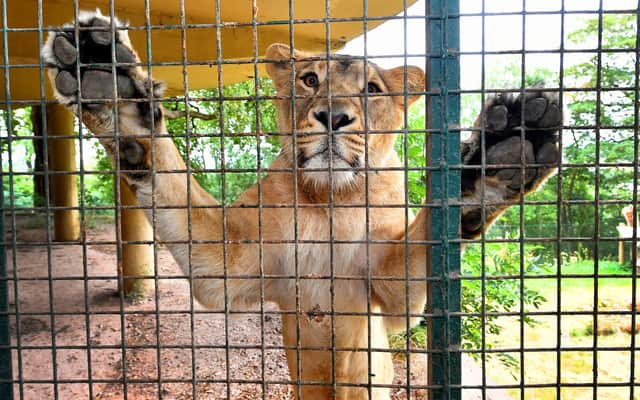

Is it possible to have a friendly lion? Maybe ‘gregarious’ would be a better adjective. I’m not sure I would fancy my chances the other side of the fence, but she certainly likes the attention, and you can see why she is a favourite with the keepers.
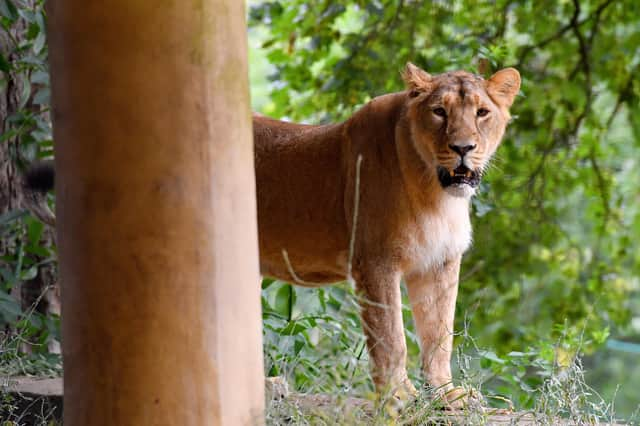
And for one day only, I am also one of the keepers, bringing food to the zoo’s exotic residents. Dudley Zoo offers regular ‘keeper for the day’ experiences and after a quick check on the wolverines, it’s time to feed the lions.
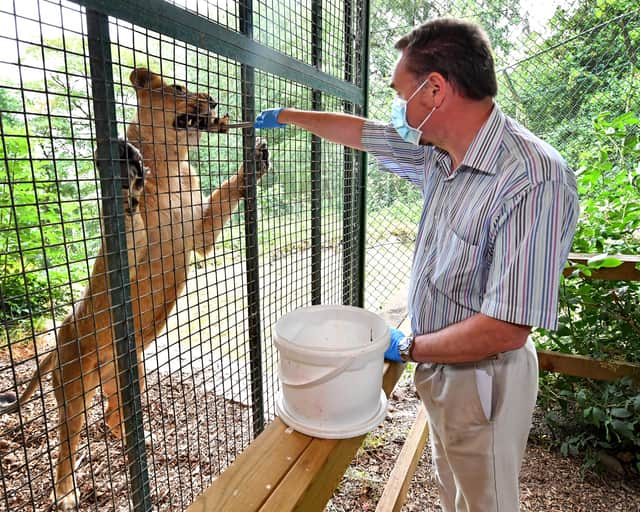
Initially I’m a little hesitant about hand-feeding a lion, nervously dropping it on Kirana’s head before it enters her huge jaws.
“If the tongs go in there, you’re going in to get them,” jokes keeper Ed. But after a couple of attempts I am more confident, and Kirana, clearly knowing which side her bread is buttered, seems eager to make it easy, obediently reaching up and taking the meat out of the tongs.
“She’s got such a big personality,” says Ed, who has worked at the zoo for more than 20 years. As we go to leave the feeding area, Kirana’s male companion Kashari tentatively comes out to see what’s going on.
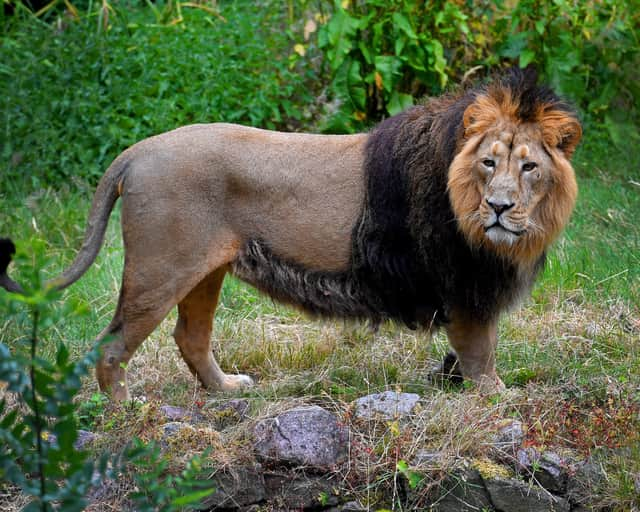
“He’s like the cowardly lion in the Wizard of Oz,” says Ed. “He’s such a big, handsome beast, but he’s terrified of his own shadow, it’s strange really.”
He’s missed out on the food this time, but Ed says he will drop some meat off in his enclosure for later, so he doesn’t go hungry.
There is no such reticence among the penguins though. Just throwing a fish in their general direction will send half a dozen entering into a rugby-style scrum. Shy they’re not.
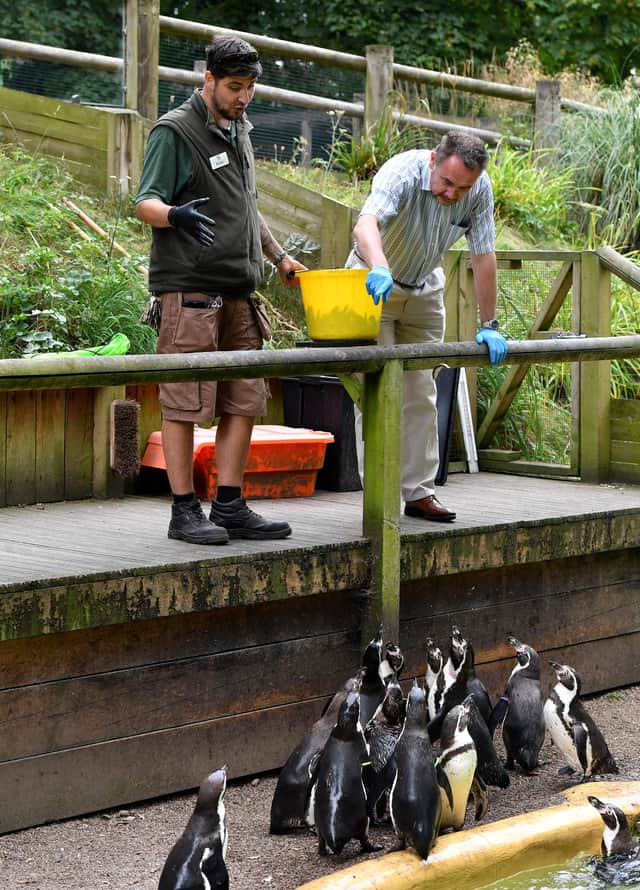
The penguins are always a big draw, says keeper Kriss Pearson, 33, who joined the zoo as a 17-year-old.
“I think it’s the comedic aspect, the way they waddle, everyone loves a penguin.”
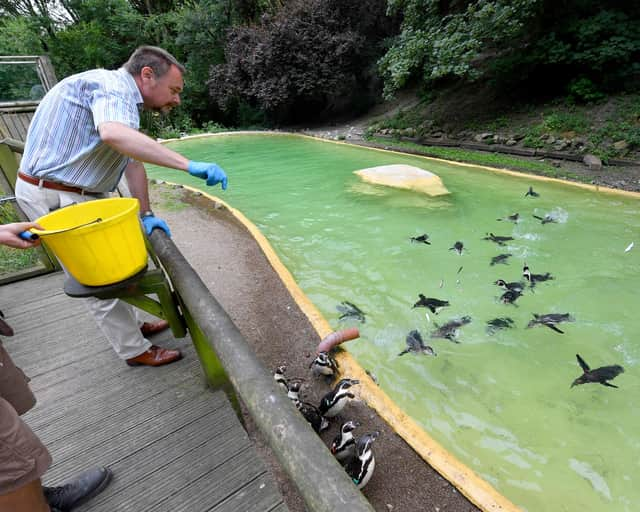
It quickly emerges they fall into two categories. If you throw a fish into the water, half of them will jump in and fight it out, while the older, more savvy ones stand unmoved on the shore.
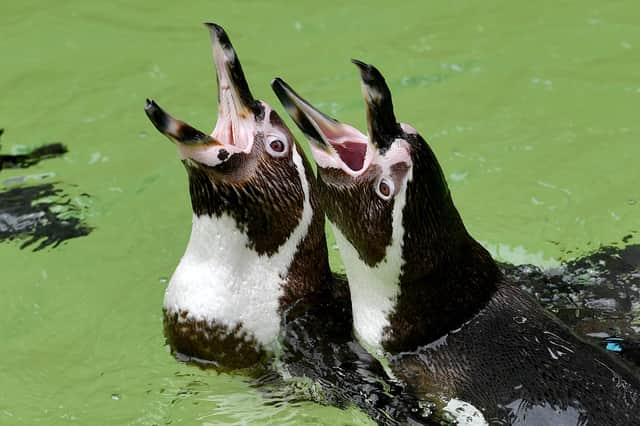
“They know they’re going to get fed, so they will stand and wait,” he says. Even so, you’re wasting your time trying to distribute the food evenly. Try to feed one penguin, and another will almost push it out the way. It’s every bird for itself.
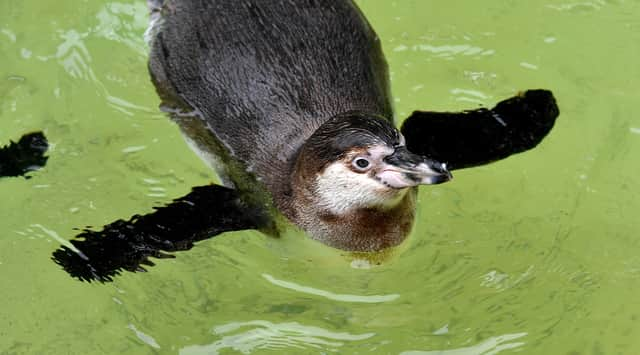
It’s heartening to see the penguins doing so well. Up until 2022, the zoo had one of the largest self-sustained colonies in the country, but then a bout of malaria struck, wiping out 65 its 70 penguins.
Since then the zoo has successfully rebuilt the colony to a healthy 32, helped by the birth of eight or nine chicks. Now twenty-somethings Nell and Rico keep a watchful eye over the younger blades.
Echo the barn owl is a different story altogether. While the penguins noisily dive in and fight over their fish, Echo silently swoops before landing on your hand.
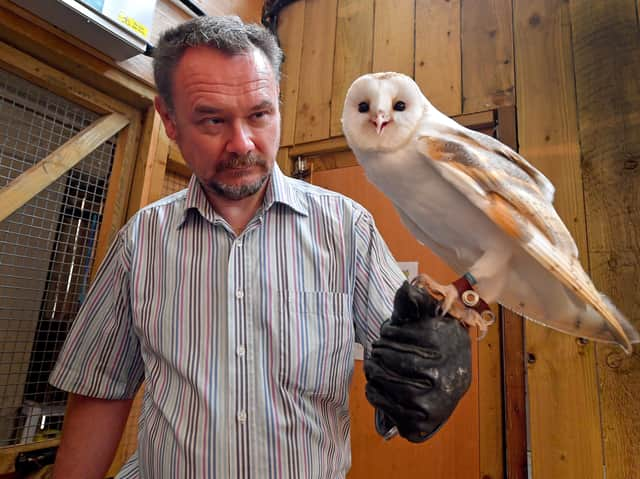
“These guys hunt through sound, rather than vision,” says Kriss. “Their eyesight isn’t all that good. When she actually tries to feed, you will notice that she actually closes her eyes, and this is because up close she can’t actually see what’s going on anyway, she will shut those eyes to try to protect them because if she has a mouse or rat, and it isn’t quite dead, its tail might flick at her, so she will close her eyes and use these whiskers each side of her beak.”
Barn conversions, which have seen their traditional habitats turned into trendy residential properties, have been a big problem for barn owls in recent years, although their numbers have now stabilised somewhat.
The surprising thing about Echo is that, beneath the huge wings and voluminous plumage, she is actually quite small.
“Underneath all those feathers, she is the size of a blackbird,” says Kriss.
It’s hard not to love Echo, with her gentle demeanour and saucer-like eyes, but it’s time to move on to the primates. And there are few more impressive creatures than the orangutans, even if their table manners leave a little to be desired.
Unlike most apes, orangs are not particularly sociable animals, to the extent where there is not even a commonly agreed collective noun: some experts talk about a ‘congress’, but I think I prefer a ‘buffoonery’, which reflects the more comical aspects of their behaviour.
Jazz, 34, and her grandson Joe, four, initially seem pleased to see us, or at least our bucket of cauliflower and broccoli. But Jazz becomes suspicious of photographer Tim’s camera lens, and escorts the youngsters away.
Jazz’s daughter Sprout, 15, is more confident, but doesn’t seem to particularly like us - at least not until we start offering her cauliflower. Suddenly, her demeanour lightens, as she crams her capacious mouth with vegetables to the point where she can can’t even close it.
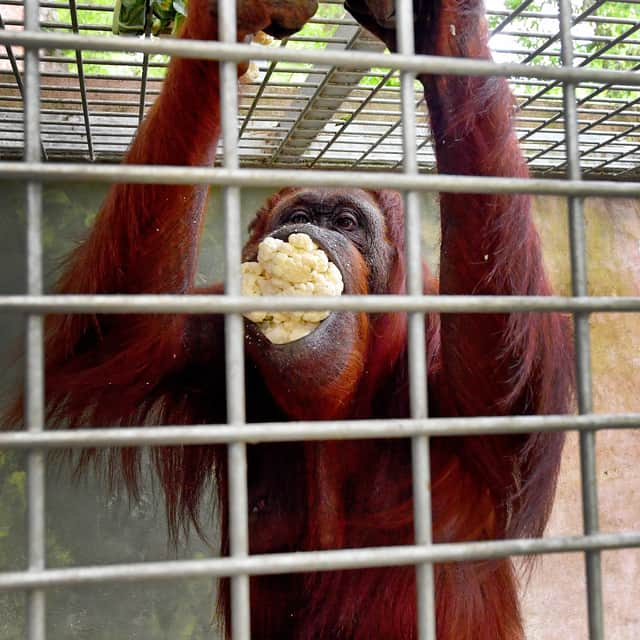
Benji, 49, is the patriarch of the buffoonery, having lived at the zoo since the age of four, but Djimat, 36, is now the leader of the pack. These seem to be the friendliest of the bunch, and seem to be enjoying the attention. But the sight of Sprout filling her face convinces Jazz and Joe that maybe we aren’t so bad after all.
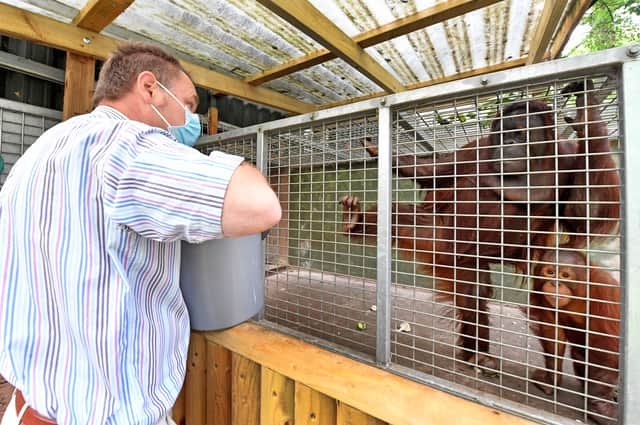
Orangutans are gentle and retiring creatures, and fascinating to watch. They are also critically endangered.
“It’s farming that is destroying their habitats,” says ape keeper Kylee Wingfield.
“You can’t blame the farmers, there is so much money to be made from palm oil. But it means they are cutting down the forests in Asia and South America at an alarming rate.”
Much more outgoing are the geladas, a species of monkey closely related to baboons, which communicate with a complex range of facial expressions. Ebano, 21, is the undisputed leader of the males, and while he might be getting on in years, he has lost none of his virility as he is quick to demonstrate.
“He’s showing his dominance by flashing his teeth,” says keeper Emma Dingley, as he squares up to a younger female, who responds by chattering her teeth and smacking her lips.
“She’s demonstrating submission,” says Emma, just as Ebano takes that as the green light for a quick spot of mating. He’s on and off in a matter of seconds, before nonchalantly walking off to check out the rest of the talent.
We throw them a few nuts, and once more it is Ebano who dominates the proceedings. As he ventures towards us, a couple of other males follow behind, nervously seeking his approval before deciding to leave the food to the big man.
There are no male chimpanzees at the zoo, but seniors Mandy, 49, and Fan, 52, need little encouragement in taking up the roles of alpha females. As I offer a watering can of tea to Mandy, she proceeds to suck the teabag out of the spout and chew it over. Mandy’s daughter Mali comes over to see what the fuss is about, but after tentatively looking to her mother for permission, she decides to decline the offer of a drink.
“Fan is a great leader,” says keeper Sally Sheridan, “she keeps everyone in check.
“She likes to let us know if anything changes in the enclosure, she alarm calls, it sounds a bit like a dog sometimes. If any little thing is out of place, she will call us, so we can check it out. They’re really intelligent, they’ve got a fantastic memory.”
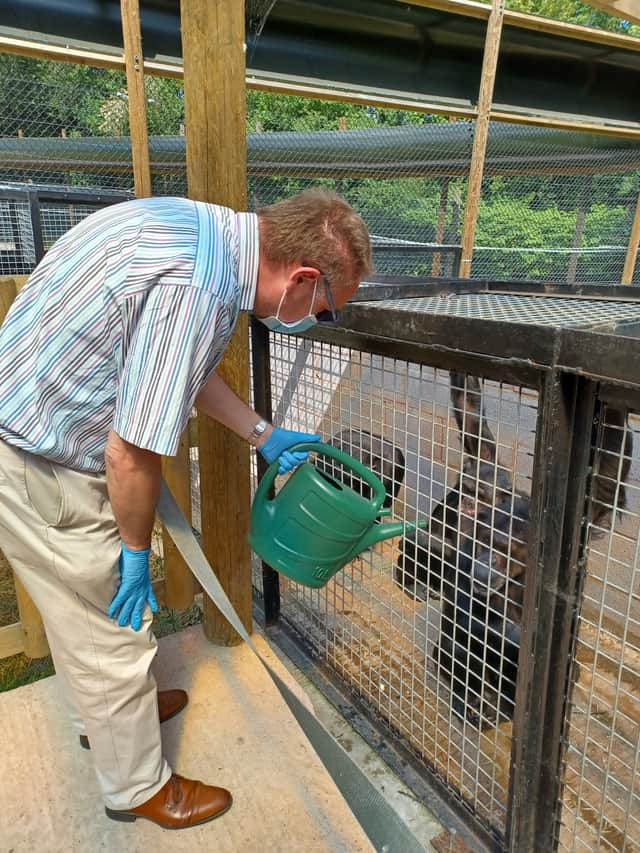
This is demonstrated when Sally asks Malaika, 38, to perform a series of tasks to earn some nuts.
“Malaika, Malaika, can I see your chest,” says Sally, as the chimp proudly puffs out her chest.
“Can you show us your foot? And your hand?”
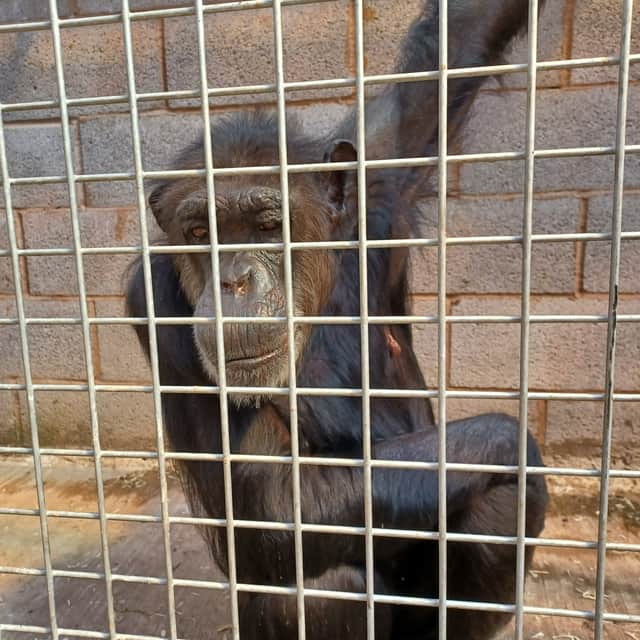
Malaika complies every time, and even knows her left from right. And this is not just a party trick.
“It helps with the health checks and veterinary care,” says Sally. “She can present her arm, which is really good training for giving them injections. The chest is a good one, it means the vet can use the stethoscope to listen to their breathing or heartbeat.”
One of the most popular species at the moment are the sloths, says keeper Esme Murphy, as she invites me into their house. I have been warned in advance that you really don’t want to get bitten by a sloth, as it will mean an inevitable visit to hospital, although I think it is still probably preferable to being bitten by a lion or chimpanzee.
“There’s a big craze for sloths at the moment, like there was for meerkats a few years ago,” says Esme. “People say they remind them of their husbands.”
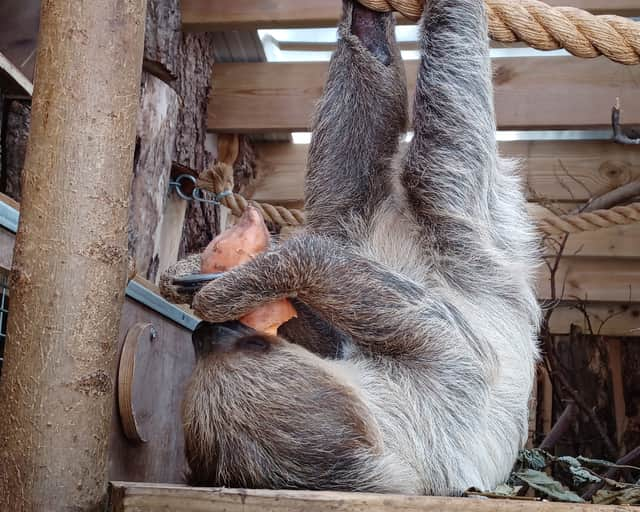
Watching the slow-moving sloths, clinging upside down from the trees by their hook-shaped claws, is a strangely compulsive experience, and they are so lethargic it is hard to imagine them motivating themselves to bite anyone. I put a few vegetables on the shelf, which they eventually motivate themselves to eat.
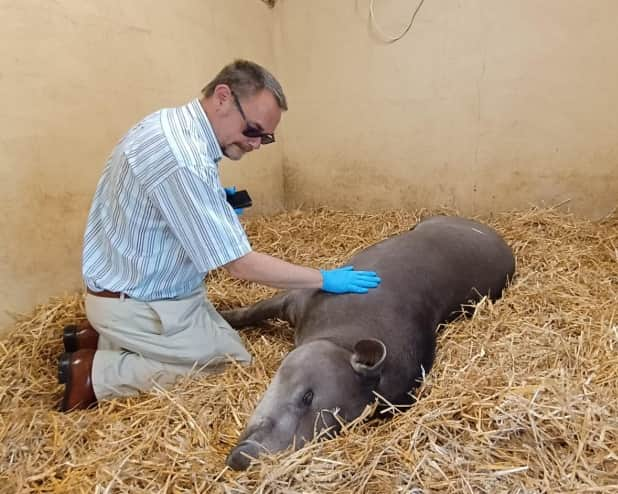
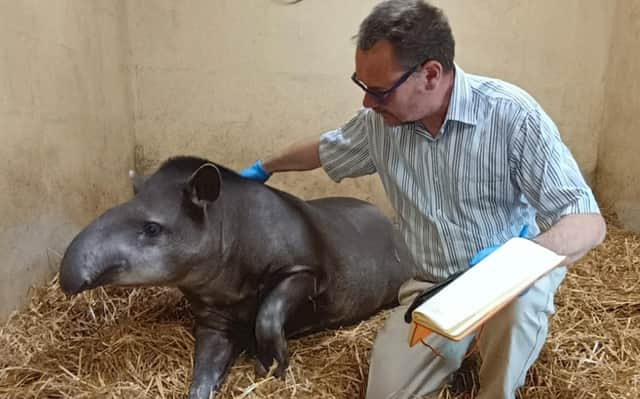
Adam Davey’s favourite animal is the tapir, which looks slightly like a pig but is more closely related to a rhino. Chico, 24, makes the sloths seem positively dynamic. Not a fan of the sunshine, he prefers to rest inside his house, although he is not averse to having his tummy tickled.
“He’s a bit like a giant dog,” says Adam. “A lot of the people who do the experience days like the tapirs because you can get so close to them.”
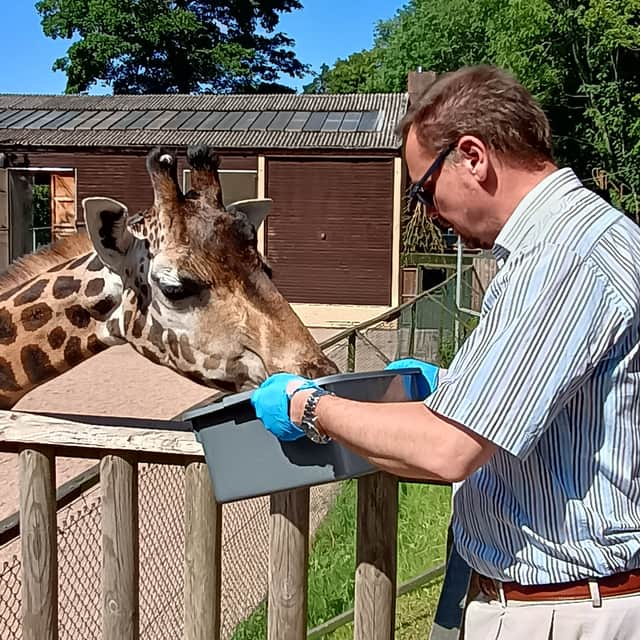
Final stop is the giraffe enclosure, where Adam introduces me to Josie, 18, and Keira, six. Giraffes are fascinating creatures, and the dream card in a game of Top Trumps. Not only do they grow to up to 18ft tall, but they can run at speeds of up to 30mph. Each has its own unique markings, and their powerful 18in tongues are ideal for reaching into trees and pulling down leaves. They are 6ft tall at birth, and can stand up within an hour of emerging from the womb. And they love to eat.
Adam has prepared two bowls of vegetables for Josie and Keira, and neither of them are shy in coming forward for it. I think feeding the giraffes was the highlight of the day, they are so graceful and docile - although the keepers warn me that you would not want to be inside the enclosure with them, as their kicks are lethal. Once the bowls have been emptied, it is time to offer them some tree branches.
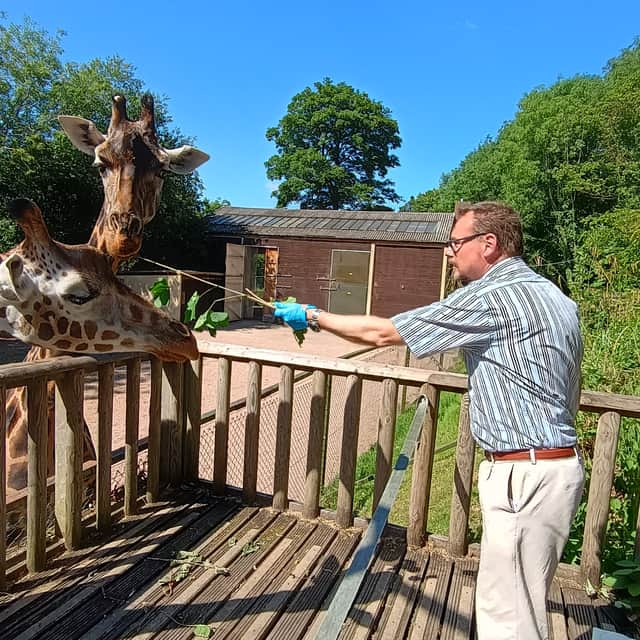
“Try to hold on to the branch, as it gives them something to pull against,” advises Adam. Feeding the giraffes is truly therapeutic.
And my working day is done. Unlike the keepers who work long, hard hours in all weathers, I’m able to clock off at four having spent the day in glorious sunshine. Nevertheless, it is easy to see why the keepers love their jobs.
“It’s all for the love of the animals, there’s no other reason why you would do it,” says keeper Ed, and every one of the creatures we have seen today has been engaging in its own different way. And you can always be sure of a good view when you’ve got a bucket of food in your hand.
For more information about Dudley Zoo’s Keeper for a Day experience, see dudleyzoo.org.uk/experiences/be-a-zoo-keeper-experience/.
Comment Guidelines
Iconic Media encourages reader discussion on our stories. User feedback, insights and back-and-forth exchanges add a rich layer of context to reporting. Please review our Community Guidelines before commenting.