
Massive, clinical... and undeniably cool - Inside the West Midlands' huge robotic Amazon distribution centre
As the grey and white cladding of Amazon's EMA4 looms out of the early morning mist in north Birmingham it's hard to ignore its scale. It is undeniably huge.


On a chilly December morning, the US firm's four-storey warehouse and distribution centre still looks shiny and new just over a year after it first opened, as it quietly imposes itself on an otherwise innocuous parcel of outer-city hinterland.
This building, notionally in Sutton Coldfield but with a road system, pathway network and postcode all of its own, is not Amazon's biggest 'fulfilment centre'. That title goes to a similar, slightly larger venue in Kent. But nonetheless, it's massive. Development at this scale is cool. Big warehouses are cool.

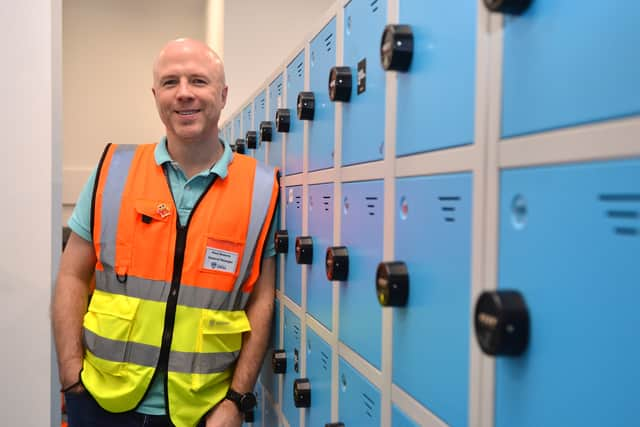
"The footprint is around 550,000 square feet - that's eight football pitches," the building's general manager Paul Roberts tells me.
"Of course that's only the bottom floor, and there's another three above this one."
Around 2,500 people work at this place, where stock is held and orders are processed, picked and packed before making their way on huge trucks to delivery centres where an even larger delivery network takes over to speed through the final miles between the warehouse and the front door.
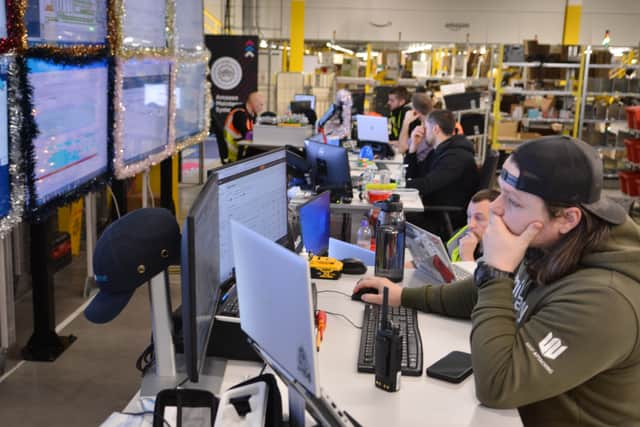
But such is the size of this place it barely feels like anyone works here at all. Small groups of staff go about their business quietly and efficiently, everyone clearly well aware of the limits of their own responsibilities. The floor is spotlessly clean.
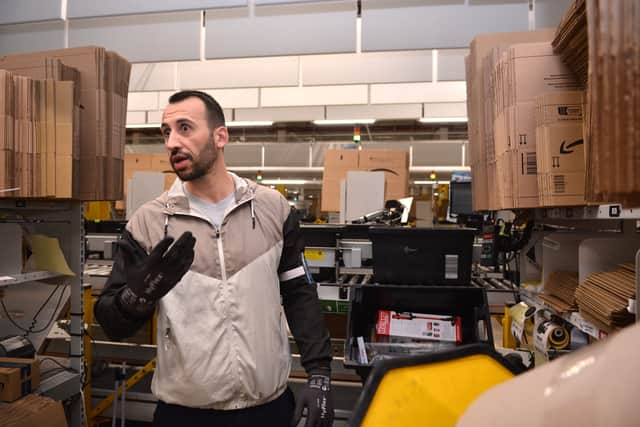
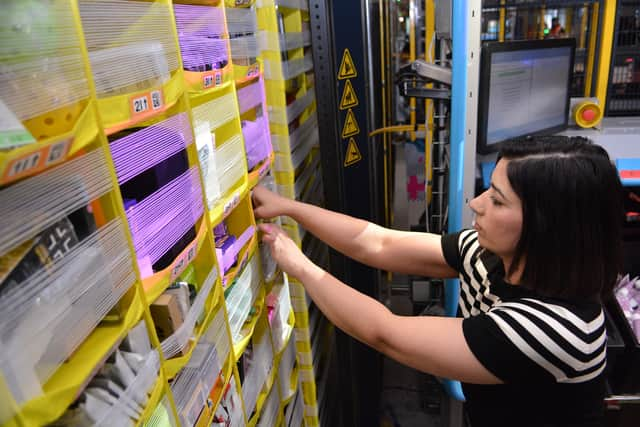
We stop to chat to a few of the workers, some of whom have obviously been queued up for my benefit, others more spontaneous.
A lady working in the stow (inventory) department tells me at length what a great place it is to work - her enthusiasm is a bit contrived but somehow also feels genuine. She tells me she likes the pay and benefits, and the flexibility of her shifts.
Over the past eighteen months hundreds of Amazon workers have been on strike over pay at the Coventry fulfilment centre, and a vote on union recognition for GMB at the facility was narrowly defeated. Amazon announced a 9.8 per cent pay increase for front-line workers in September.
As we pass through the factory following the dizzying journey of the inventory which comes in through the huge loadings bays, delivered on trucks from suppliers across the world, Paul is explaining a bewildering array of barcodes, scanners and AI powered cameras used to track items through the serpentine network of conveyor belts and robot-driven inventory stacks, while I squeeze off a few pictures.
He's also keen to talk about the several thousand floor robots, which are prompted by online orders and track themselves around the site using barcodes on the floor, scuttling along from storage area to picking station and back again in ways which are calculated to be both minutely and infinitely more efficient than human intervention.
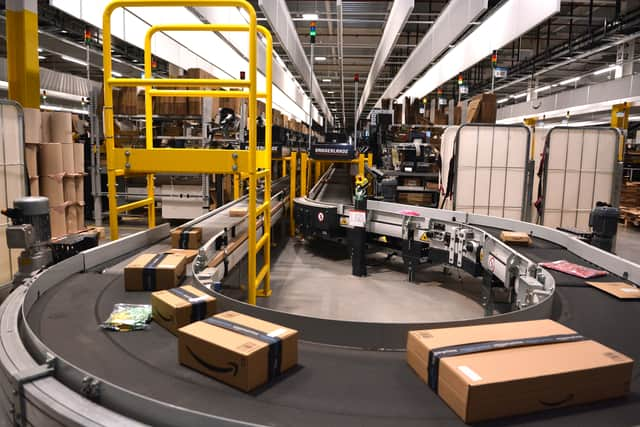
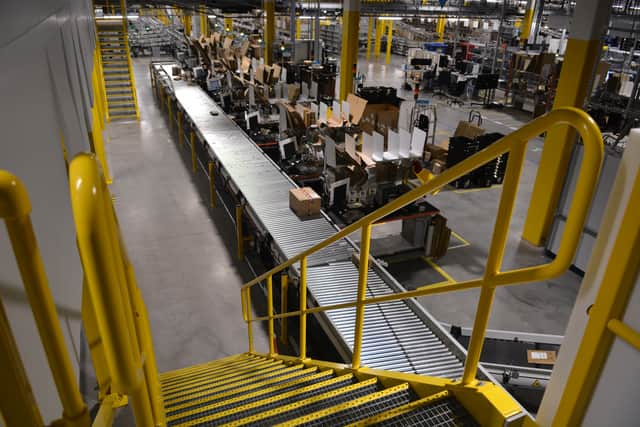
This is proprietary Amazon technology which I'm not allowed to photograph, and features an array of cameras and sensors with which each drone picks up huge stacks of inventory before delivering them to the right place without so much as a click of a mouse, before returning itself to a charging point before running out of juice. As he explains the process, my mind wanders to a post-apocalyptic world where the self-charging floor robots are endlessly shuffling stuff around, arranging inventory and optimising storage in minutely efficient detail for no-one at all. Cool.
Aside from the scale, or perhaps because of it, the other thing you immediately realise is the sheer amount of 'stuff' which is being held here.
Four floors worth of every kind of stuff you can possibly imagine, from air-fryers to books to laptops - it's all here somewhere. The electric toothbrush I ordered earlier this week, which arrived within about 12 hours, undoubtedly passed through the huge loadings bays of this building at some point. Leaving aside the face that our relationship with stuff is undoubtedly problematic from all sorts of perspectives, you have to admire the clinical and total efficiency with which it's administered here.
This is the Notre Dame of stuff, a 100ft-high, half-a-kilometre-long cathedral to our obsession with stuff - some of it necessary stuff, quite a lot of it doubtless completely frivolous stuff.
It is, possibly, the ultimate embodiment of our love of stuff, an obsession so powerful and so prolific that we have to build warehouses with over two million square feet of storage just to keep it in, then design wildly clever robots to move about such huge piles of it. And that's just for this region alone.
Amazon has over 20 fulfilment centres across the country and nearly 200 more across the world, as the firm has blossomed from a simple online bookseller to being the leading supplier, holder and distributor of the world's supply of stuff.
Are we better off for having so much of this stuff available to us? Is this humankind working at its greatest levels of superficial achievement? Or just a big warehouse full of stuff? At the end of my tour, I still genuinely don't know.
But the vertiginous infrastructure Amazon has built to move it all around is so vast, so impressive, and so efficient, that as you emerge blinking into the sunlight from the entrance hall to this cavernous distribution centre, you simply can't help but appreciate, well - how cool it all is.
Comment Guidelines
Iconic Media encourages reader discussion on our stories. User feedback, insights and back-and-forth exchanges add a rich layer of context to reporting. Please review our Community Guidelines before commenting.