
Black Country will become Britain’s first ‘industrial stronghold’, Reform’s Jenrick tells Wolverhampton rally

Free rates, relaxed planning rules and tax incentives for region if Reform wins election, Jenrick promises
The Black Country will become the centre of an “industrial stronghold” with 10 years’ free rates, tax-relief on brownfield regeneration, and cuts to National Insurance contributions if Reform wins the next general election, the party’s Treasury spokesman said this afternoon.
Robert Jenrick was in Wolverhampton to announce that the region would be the first of a number of “strongholds” which aimed to bring investment and high-quality jobs back to Britain’s forgotten towns and cities. These will be defined geographies that will benefit from radical tax and planning incentives.
The Black Country scheme would cover the local authority areas of Cannock, Dudley, Sandwell, Walsall and Wolverhampton, he said.
Echoing the Enterprise Zone policy of the 1980s, which led to the creation of the Merry Hill shopping centre, Mr Jenrick said each stronghold area would offer radical tax breaks and incentives to spur reindustrialisation.
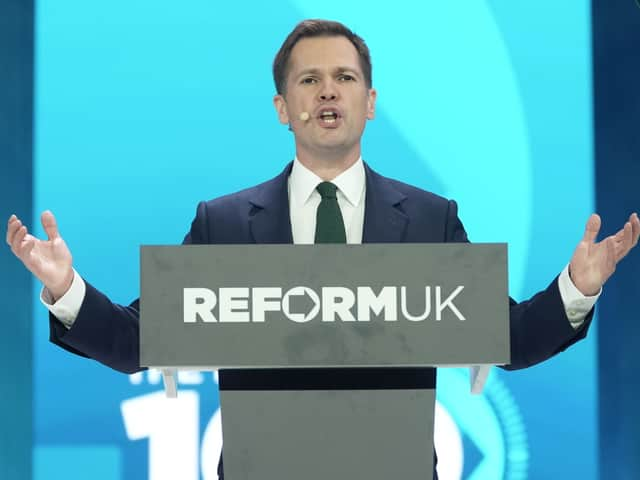

These incentives will be offered for a fixed 10-year period and will include streamlined planning, the halving of employers’ National Insurance on net new hires, full expensing on property and plant equipment and full exemption of business expansion from business rates.
These strongholds will be established in the regions hit hardest by successive Conservative and Labour governments, beginning with the Black Country, Mr Jenrick said.
Each stronghold area will be offered radical tax breaks and incentives to spur reindustrialisation. These incentives will be offered for a fixed 10-year period and will include streamlined planning, the halving of employers’ National Insurance on net new hires, full expensing on property and plant equipment and full exemption of business expansion from business rates.
He said that despite many challenges, the Black Country retained the foundations for recovery.
“It has a resilient manufacturing base, substantial brownfield land ready for redevelopment, and direct motorway access via the M5, M6 and M54. Industrial strongholds will supply both political will and the right incentives to reindustrialise an area brimming with potential.”
Mr Jenrick told party members at the Grand Station banqueting suite - Wolverhampton’s former Low Level railway station - that a Reform government will create industrial strongholds to bring industry back to the places that invented it.
“In every one, businesses will get big tax breaks if, and only if, they grow and develop their firms there,” he said.
“And by enabling these businesses, by getting out of their way, we will bring industry back to this country.
“And the very first one in Britain will be in and around the Black Country. All of it: Wolverhampton, Dudley, Sandwell, Walsall and Cannock.
“A new deal for every street, every trade, and every firm, whatever its size.”
Each industrial stronghold will be a defined geographical area, within which businesses will benefit from significant incentives for growth. These will include:
- Employer National Insurance contributions reduced by 50 per cent for the first £50,000 of earnings for net additional employees for five years.
- 100 per cent first-year tax relief on new brownfield residential buildings, extensions and substantial improvements.
- 10-year exemptions on the extra business rates that result from new investment, from improvements, and from establishing a business in a high street retail unit that has been vacant for more than two years.
- Streamlining planning policy by creating a presumption in favour of development according to an updated local plan, with a strictly limited set of circumstances in which planning applications can be refused.
He said that since the year 2000, 390,000 industrial jobs had been lost in Britain.
“Much of this deindustrialisation has been driven by the pursuit of renewables which has left us with industrial energy prices that are 63 per cent above the international median,” said Mr Jenrick.
He said Denby Pottery in Stoke-on-Trent, which was founded in 1809, specifically cited high energy costs in its decision to close this year.
“In the Black Country alone, around 7,000 jobs were lost in 2024, with a steady stream of major sites closing in recent years such as Krispy Kreme’s Tipton production facility which employed more than 50 people and closed in October 2026,” he said.
Mr Jenrick said Reform UK had already committed to restarting licensing for new oil and gas fields, abolishing the energy profits levy and the emissions trading scheme in addition to repudiating AR7 contracts for difference and scrapping AR8.
Comment Guidelines
Iconic Media encourages reader discussion on our stories. User feedback, insights and back-and-forth exchanges add a rich layer of context to reporting. Please review our Community Guidelines before commenting.