
Space boffins in black hole breakthrough
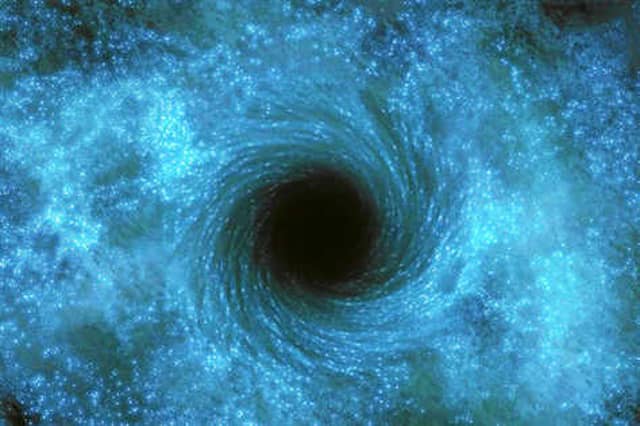

Ground-breaking Birmingham scientists have discovered a black hole, the first of its type detected outside the immediate vicinity of our galaxy.
Ground-breaking Birmingham scientists have discovered a black hole, the first of its type detected outside the immediate vicinity of our galaxy.
The so-called 'garden variety' black hole was detected in the Centaurus A galaxy, which is over 12 million light years away.
According to theory, black holes should exist everywhere in the universe.
There is a supermassive type at the heart of each large galaxy, weighing at least a million times that of the Sun, and millions of ordinary ones, a few times the mass of the Sun, sprinkled throughout each galaxy. Black holes are notoriously difficult to detect, since they do not emit any light.
They are found generally as a consequence of the effect of their intense gravity on their surroundings, such as devouring nearby stars.
The work is part of a collaboration involving academics from universities in the USA, Canada, South America and Europe, who used NASA's Chandra X-ray observatory, which is in orbit around the earth, to carry out some of the longest observations ever performed of a single galaxy. Using these observations, a team belonging to the University of Birmingham's Astrophysics and Space
Research group, detected a point-like X-ray source 50,000 times the brightness of our sun. Over the two-month span of the observations, the source faded by a factor of 100 in brightness.
Lead author, Mark Burke, PhD student at the University of Birmingham said: "Celestial sources don't vary so dramatically over such short periods of time. We were able to show that this could only happen if a black hole is the cause of this phenomenon."