
I was at Villa Park to watch the controversial Maccabi Tel Aviv fixture but by the final whistle the story wasn’t on the pitch—it was off it
Former Dudley College lecturer and ex-Birmingham poet laureate, British Asian Roshan Doug, is also an Aston Villa fan. These are his thoughts on his visit to Villa Park for the Europa League game against Maccabi Tel Aviv.
Over the past few weeks, there’s been no shortage of hype—both national and international—about last night’s UEFA Europa League clash between Aston Villa and Israel’s Maccabi Tel Aviv.
If you’d listened to the warnings on radio and television, you’d have thought Birmingham was preparing for an invasion rather than a football match. Schools, we were told, might close early. Buses would be diverted. The area around Villa Park, supposedly, would descend into chaos, with police stretched to breaking point and angry mobs clashing in the streets.
Naturally then, my son and I turned up expecting to step into something resembling a war zone. For weeks, social media had been bubbling with talk of disruption.
Groups claiming solidarity with Gaza and Palestine had announced their plans to stage a large protest outside the stadium.
Local politicians and activists, too, had been outspoken in their criticism of the club for allowing the game to go ahead.
Even some figures within Birmingham City Council had chimed in, as though hosting an Israeli football team was a political act rather than a sporting fixture.
And yet, to their immense credit, Aston Villa’s board refused to buckle. They stood firm, declining to cancel or postpone the match despite pressure from those who wanted to turn football into another battleground for international politics.
Whatever one’s personal view on the Middle East, Villa deserve credit for showing courage and principle—a rare quality in an age when corporate institutions often cave in to the loudest voices.
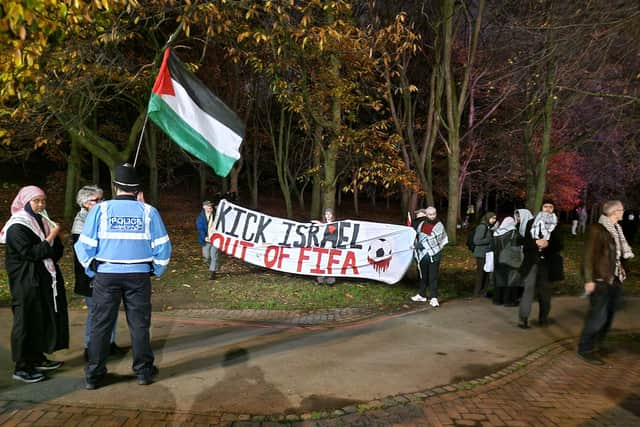
Yes, there were protests. A few dozen demonstrators gathered outside the Doug Ellis Stand, waving Palestinian and Gaza flags while chanting “From the river to the sea” through megaphones.
Among them were the usual suspects—the Socialist Workers, the Anti-Nazi League, and that ever-present assortment of professional activists who seem to thrive on public outrage. Their banners were loud, their slogans predictable, and their anger—well-rehearsed.
They performed in front of endless journalists, cameras, social media commentators and, the curious burger-munching fans like us who were wandering around feeling reasonably safe.
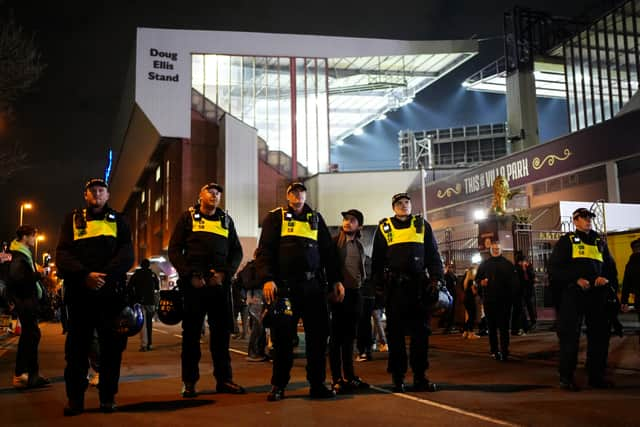

So credit where it’s due: the police and security presence was exceptional. The area around Villa Park was heavily manned by armed officers, private security staff, and the club’s own stewards. Every car was checked, every ticket scanned, every bag inspected. There was an unmistakable air of control and coordination. Even as crowds gathered, the operation was calm, disciplined, and quietly impressive.
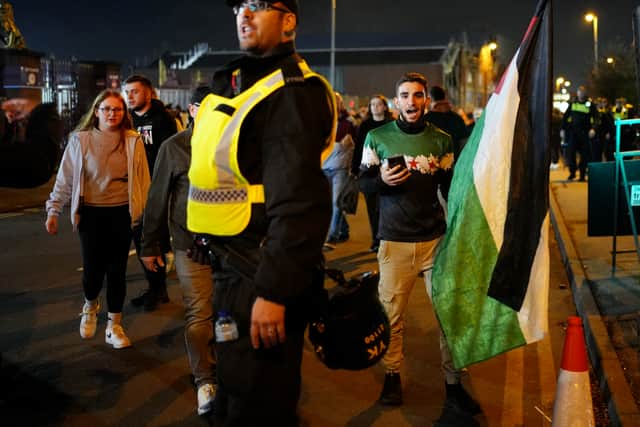
What did catch my eye, however, were the groups of masked youths across the street, shouting, gesturing, and hurling insults from behind balaclavas.
We even had bottles flying towards us. I couldn’t help but wonder whether they were being monitored with the same rigour as the paying fans inside the stadium. Policing football supporters has become an art form in Britain—but policing politically motivated mobs remains a more delicate, and often inconsistent, affair.
Still, Aston—so often in the news for the wrong reasons—remained calm. There was order. Police vans were parked strategically across the main roads, while a large surveillance drone hovered quietly above the stadium. My son, who happens to be a pilot, identified it immediately—while I, in a less technical moment amidst the darkness of an autumn evening, insisted it was either a plane or a helicopter.
As for the football itself? In truth, it was a little flat, a lacklustre performance from both teams. Yes, we won. Maatsen scored just before half-time, and Malen doubled the lead with a penalty after the break. There were flashes of flair and a few lively exchanges, but little to stir the blood.
The most entertaining moments were when Villa fans would break into song, mocking the empty away section with the familiar chants: ‘You only sing when you’re winning!’ and, ‘It’s all gone quiet over there!’
By the final whistle, though, the story wasn’t on the pitch—it was off it. Despite the predictions of turmoil, the night ended with only 11 arrests. No riots. No mass brawls. No headlines of horror.
In an era where outrage makes the news and calm rarely does, perhaps that was the evening’s quietest, and most significant, victory of all.
Comment Guidelines
Iconic Media encourages reader discussion on our stories. User feedback, insights and back-and-forth exchanges add a rich layer of context to reporting. Please review our Community Guidelines before commenting.